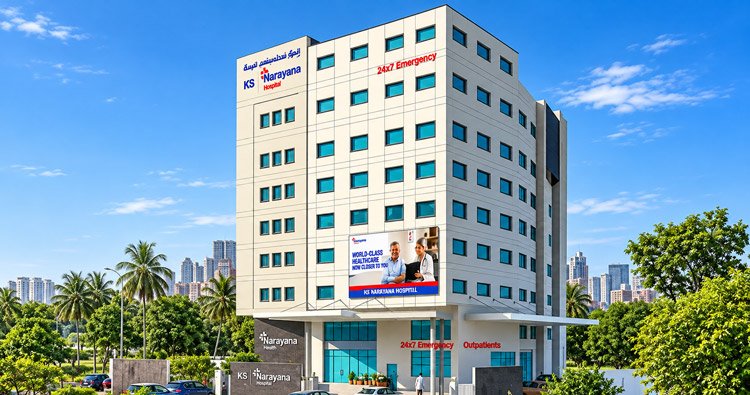
Bengaluru: Narayana Health has introduced a fully paperless digital operating model at its KS-Narayana Hospital in Banashankari, Bengaluru, marking a significant step towards technology-driven hospital management and improved patient experience.
The 110-bed facility integrates digital systems across outpatient and inpatient services, reducing the need for physical paperwork, manual billing processes and traditional administrative counters. The initiative is designed to make hospital visits more convenient while improving coordination, transparency and operational efficiency.
The digital transformation covers 11 key stages of the patient journey, comprising five outpatient services and six inpatient processes. These services are integrated through the hospital’s digital platform, with WhatsApp and the Narayana Health NHCare application serving as important communication channels.
Digital services simplify outpatient care
For outpatients, the paperless system begins with registration. Patients can register through kiosks or hospital counters, obtain a patient identification number and schedule appointments or register as walk-in visitors without completing conventional paper forms.
Consultation payments and service-related billing are also handled digitally. Doctors’ orders for diagnostic tests and procedures are linked to the patient’s visit, helping eliminate the need for separate billing transactions.
The hospital has also introduced digital queue management. Patients can receive their tokens through WhatsApp or NHCare and follow their position in the queue. The system also supports doctor-wise queue information and waiting-time updates.
Pharmacy services have been integrated into the digital process. Prescriptions are transferred to the pharmacy system, allowing patients to make digital payments and collect their medicines through a dedicated service channel.
Paperless admission and discharge for inpatients
The digital model extends throughout the inpatient experience. Before admission, patients and their families can receive cost estimates based on applicable treatment packages and daily hospital charges.
Consent procedures are facilitated through digital channels, including WhatsApp and NHCare, reducing dependence on physical consent forms. Admission-related activities, such as document submission, advance payments, bed allocation and generation of inpatient identification numbers, are also supported through digital workflows.
During hospitalisation, a digital companion service enables patients and their families to register requests and complaints. These are converted into service tickets and escalated through a defined three-level mechanism, with a stated 30-minute service-response target.
Discharge procedures have also been digitised. Discharge notifications, summaries, final bills and payment links are communicated electronically, helping reduce paperwork and administrative delays.
The process concludes with digital gate passes in QR-code format for visitors, attendants and patients leaving the hospital.
Technology-led approach to hospital management
The digital operating model uses ATHMA, Narayana Health’s hospital management software, alongside its patient-facing digital channels to connect different stages of hospital operations.
By bringing registration, billing, consultations, pharmacy, admission, patient support and discharge into an integrated workflow, the hospital aims to reduce fragmented processes and improve the overall patient experience.
The initiative also reflects Narayana Health’s broader interest in rethinking conventional hospital administration through technology and more efficient use of healthcare professionals.
KS-Narayana Hospital was established by Kammavari Sangham and is operated by Narayana Hrudayalaya under an operation and management agreement. The 110-bed hospital commenced commercial operations in October 2026.
A step towards digitally enabled healthcare
The Banashankari facility represents an approach in which digital technology supports both clinical service delivery and the administrative processes surrounding patient care.
Reducing paper-based transactions can help minimise repetitive documentation, improve access to patient-related information and create better coordination between departments. The use of familiar digital communication channels may also make hospital services easier to navigate for patients and their families.
As healthcare providers increasingly explore integrated hospital information systems, Narayana Health’s Banashankari model offers an example of how digital workflows can be extended beyond electronic medical records to cover the entire hospital experience.
(Photo: AI-generated)