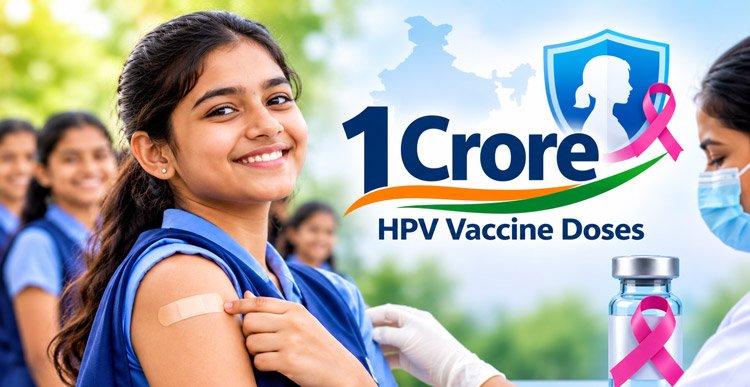
India has achieved a major milestone in cervical cancer prevention, with more than 1 crore doses of the Human Papillomavirus (HPV) vaccine administered under the National HPV Vaccination Campaign in less than nine months of its launch. The achievement marks a significant step towards protecting adolescent girls from HPV infections that can cause cervical cancer and expanding preventive healthcare across the country.
Launched by Prime Minister Shri Narendra Modi in February 2026, the nationwide campaign provides free, safe and voluntary single-dose HPV vaccination to 14-year-old girls at Government health facilities, with parental consent. The initiative reflects India’s growing focus on preventive healthcare and safeguarding the health of future generations.
The campaign has achieved nearly 87% cumulative coverage against an annual target of approximately 1.2 crore girls, based on Registrar General of India (RGI) 2021 population estimates. Reaching the 1 crore-dose milestone highlights the campaign’s scale and momentum, supported by coordinated efforts of States and Union Territories, healthcare professionals, frontline workers, teachers, parents and communities.
Six States Achieve 100% Coverage; Strong Progress Nationwide
States and Union Territories have made significant progress in expanding HPV vaccination, with six States — Gujarat, Uttar Pradesh, Andhra Pradesh, Mizoram, Madhya Pradesh and Bihar — achieving 100% coverage of their identified target populations.
Among other high-performing States, Assam recorded 95.63% coverage, followed by Telangana (95.28%), Karnataka (93.16%) and Uttarakhand (90.17%).
Chhattisgarh (86.21%) and Rajasthan (85.23%) have crossed 80% coverage, while Kerala (77.02%), Tamil Nadu (76.12%), Odisha (74.90%) and the Union Territory of Dadra and Nagar Haveli and Daman and Diu (72.99%) have achieved more than 70%.
In absolute numbers, Uttar Pradesh leads with more than 29.33 lakh girls vaccinated, followed by Bihar with over 13.70 lakh and Gujarat with over 7.75 lakh.
Progress across States with diverse geographical, demographic and socioeconomic conditions highlights the campaign’s extensive reach and the effectiveness of locally adapted implementation strategies.
Centre-State Coordination Drives Nationwide Effort
The milestone reflects close coordination between the Union Ministry of Health and Family Welfare and State and Union Territory Governments, supported by district administrations, public health institutions and frontline healthcare teams.
States have adopted tailored approaches to expand access in rural, urban, remote and geographically challenging areas. State-led initiatives in Bihar, Tamil Nadu and Sikkim have also been integrated into the national campaign to strengthen outreach.
Community engagement, parental awareness and credible, science-based information have been central to the campaign. Healthcare professionals, including paediatricians, gynaecologists and specialists from institutions such as AIIMS, have helped build awareness and address concerns about vaccine safety and effectiveness.
Teachers, Accredited Social Health Activists (ASHAs), Auxiliary Nurse Midwives (ANMs) and other frontline workers have engaged parents and communities, encouraging informed participation and countering misinformation.
These collective efforts have strengthened public confidence and supported wider acceptance of HPV vaccination.
U-WIN Strengthens Digital Monitoring and Access
Digital health infrastructure has played an important role in the campaign, with the U-WIN platform supporting real-time monitoring, beneficiary tracking and digital vaccination records.
Programme managers use the platform to monitor district-level progress, identify coverage gaps and girls yet to be vaccinated, and improve planning and resource allocation.
U-WIN also enables parents to book vaccination slots and download digital certificates, making the process more accessible, convenient and transparent.
Combining digital monitoring with field-level implementation is helping States strengthen programme management and reach eligible beneficiaries.
HPV Vaccination: A Proven Intervention Against Cervical Cancer
Cervical cancer remains a significant public health concern and a major cause of illness and death among women. Persistent infection with certain high-risk types of HPV is responsible for the vast majority of cervical cancer cases.
HPV vaccination is one of the most effective preventive measures against infections that can lead to cervical cancer.
The national campaign is supported by global scientific evidence on vaccine safety and effectiveness. More than 800 million HPV vaccine doses have been administered worldwide, while nearly two decades of research and real-world experience have demonstrated strong protection against vaccine-targeted HPV infections and associated precancerous conditions.
Vaccinating girls at 14 years aims to provide protection well before potential exposure to HPV, contributing to the long-term prevention of cervical cancer.
Beneficiary Safety Remains a Priority
The safety and well-being of every beneficiary remain central to the campaign.
Vaccination sessions are conducted at designated Government health facilities under the supervision of trained Medical Officers. Sites are linked to 24×7 healthcare centres to facilitate prompt assessment and management of any rare Adverse Events Following Immunization (AEFI).
The campaign follows established safety protocols, supported by trained healthcare personnel and appropriate medical arrangements.
The Ministry continues to emphasise transparent communication, scientific evidence and informed parental consent to maintain confidence in the programme.
Sustaining Momentum Towards Universal Coverage
Following the 1 crore-dose milestone, the Ministry of Health and Family Welfare remains focused on reaching the remaining eligible girls and expanding coverage across all States and Union Territories.
The Ministry will continue working with State Governments, district administrations, medical professionals, frontline workers, educational institutions and communities to address coverage gaps, strengthen awareness and ensure equitable access.
Parents and guardians of eligible 14-year-old girls are encouraged to visit their nearest designated Government health facility or use the U-WIN platform for information and vaccination bookings.
Administering more than 1 crore HPV vaccine doses in less than nine months is more than a numerical achievement. It represents a significant investment in the health of India’s adolescent girls and the prevention of a potentially life-threatening disease.
The milestone underscores India’s commitment to accessible preventive healthcare and reducing the burden of cervical cancer. Every dose brings the country closer to a future in which fewer women suffer from this preventable disease.
(Courtesy: pib.gov.in)