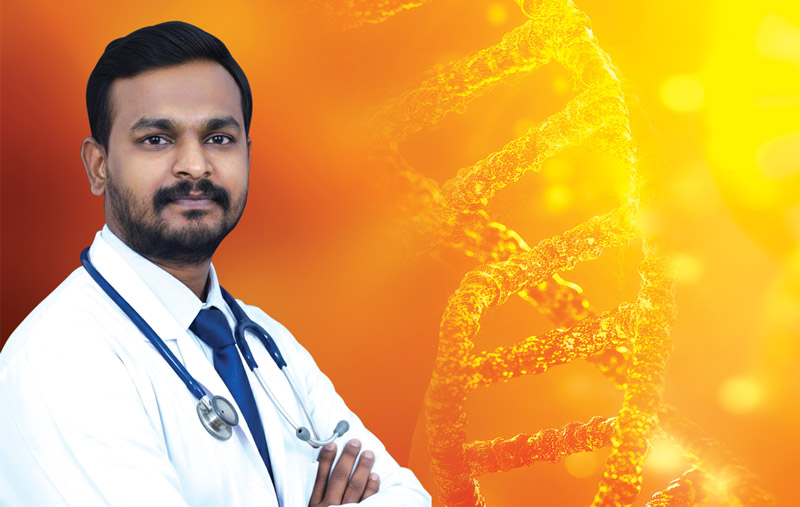
In this in-depth interview with Medical Tourism Today, Dr. Roshan Daniel shares his journey into medical genetics and the vision behind Kerala’s pioneering Comprehensive Rare Disease Clinic. He discusses breakthrough advances in genomics, real-world patient impact, and how India is rapidly emerging as a global leader in precision medicine.
Dr. Roshan, could you tell us about your journey and what inspired you to specialize in medical genetics?
Medical genetics fascinated me from the very beginning. It sits at the bleeding edge of medicine, at the intersection of science, technology, and clinical care. What drew me in was the fact that this field is driven by two massive breakthroughs happening simultaneously — first, in diagnostics with Next-Generation Sequencing, which allows us to understand the human genome with incredible precision; and second, in therapeutics, with gene therapy, enzyme replacement therapy, stem-cell transplants, and targeted cancer treatments fundamentally changing outcomes for diseases once considered untreatable.
There are still very few trained specialists in India, and I felt a strong purpose to contribute to this emerging discipline. My fascination with molecular biology and disease pathways naturally evolved into a desire to apply genetics in real-world clinical settings. Today, seeing science translate into life-changing treatments for patients is what keeps me deeply committed to this field.
The launch of Kerala’s Comprehensive Rare Disease Clinic was a milestone. What motivated this initiative?
Genetics is still under-recognized outside major metros in India, and Kerala did not have a structured clinical genetics program despite the burden of genetic and rare diseases. I wanted to bring the best of modern genetic medicine back home, where families could benefit without having to travel far or delay diagnosis.
From preventing hereditary cancers to targeted therapies that can completely change the course of certain cancers and rare disorders, the impact of genetics on patient outcomes is extraordinary. Establishing this clinic was about building access, awareness, and a system where families in Kerala could receive international-standard genetic care, timely diagnosis, advanced genetic testing, and guided treatment — without leaving the state.
As Head of the Department of Medical Genetics, what are the most common genetic disorders you encounter?
We see a broad range of patients — from newborns to adults — reflecting the full spectrum of genetic medicine. In children, we commonly evaluate developmental delay, congenital anomalies, growth abnormalities, neurodevelopmental syndromes, skeletal dysplasias, metabolic and mitochondrial disorders, and primary immunodeficiency conditions.
In adults, we frequently encounter early-onset or familial diseases involving the heart, nerves, muscles, kidneys, and blood, as well as hereditary cancer syndromes.
Reproductive genetics forms a major part of our work, including recurrent pregnancy loss, infertility, abnormal ultrasound and serum screening results, and preconception counseling. We also run specialized programs for neuromuscular diseases, rare pediatric disorders, and hereditary cancers, allowing us to support patients across life stages.
One memorable case involved a 19-year-old young woman with ichthyosis. Her family had been fearful of having another child for almost two decades. They had an unplanned pregnancy and approached us believing termination was their only option. We first identified the exact variant in their older daughter, then conducted prenatal testing in the new pregnancy. The baby was found to be unaffected. The family’s relief and joy were overwhelming. Many families still do not know that such precise genetic guidance is possible — and that it can completely change the future for them.
Another powerful story is of a patient with stage 4 lung cancer with brain metastasis, where the prognosis was only three to six months. We performed tumor NGS, identified an EGFR mutation, and the patient was started on osimertinib. Today, three years later, the patient is alive and doing well. This is the true power of precision medicine — turning what once looked like the end into a new beginning.
What recent advancements in diagnostic genetics are transforming patient care?
The past few years have redefined genetic diagnostics. Rapid exome and genome sequencing in critically ill newborns, high-precision NGS panels, liquid biopsy, and AI-assisted variant interpretation have moved from research labs into routine clinical practice. These technologies are enabling faster and more accurate diagnosis, reducing diagnostic odysseys, and allowing earlier intervention — often altering outcomes dramatically in children and cancer patients.
How do you see genomics reshaping the future of healthcare in India?
We are moving towards precision public health, where genetics becomes integrated into routine pediatric, oncology, neurology, and reproductive care. With increasing public awareness, more trained professionals, and expanding genomic lab networks, genetic medicine in India will become not only mainstream but essential. The shift from reactive treatment to predictive and preventive medicine will redefine patient care at the population level.
What are the biggest challenges India faces in implementing precision medicine widely?
Awareness among clinicians, limited trained genetic specialists, cost and insurance gaps, and the need for standardized, accredited testing platforms remain challenges. However, these barriers are rapidly narrowing. Training programs, national rare disease initiatives, affordable testing solutions, and improved clinical–laboratory integration are moving the country forward quickly.
With growing interest in precision oncology, how can genetic testing personalize cancer care?
Cancer genomics allows us to identify hereditary predispositions, choose precise therapies, predict treatment response, and implement targeted surveillance for at-risk family members. Our oncology genetics program emphasizes timely tumor and germline testing, multidisciplinary tumor boards, and long-term family surveillance — ensuring that care is not just treatment-centric but prevention-focused.
Tell us about Genetidoc and how it improves access to genetic care.
Genetidoc Genetic Clinic and DNA Testing Lab integrates online access with physical clinic support, making genetic consultation and testing possible for patients across India, including remote regions. We offer home sample collection, personalized test planning, specialist consultations, and structured post-test counseling, including second-opinion report interpretation. The goal is to democratize genetics and ensure that expert guidance reaches every family that needs it — not just those with access to major city hospitals.
Do you see India emerging as a global genomics destination?
Yes, absolutely. India has the expertise, infrastructure, turnaround speed, and cost advantage to become a key global hub. With increasing NABL-accredited genomic labs and advanced clinical programs, the country is poised to attract patients seeking affordable and high-quality precision medicine.
Your message to young doctors entering this field?
Genetics is the future of medicine. It combines science, clinical logic, and human connection. Stay curious, stay updated, and don’t hesitate to step into emerging fields — the impact you can create is extraordinary. Most importantly, remember that behind every genome is a family seeking answers and hope. Compassion and communication remain the core of this profession.
| Dr. Roshan Daniel – MBBS, MD Pediatrics, DM Medical Genetics, ECMGG (European Board Certified) – Post Graduate Diploma in Precision Oncology – Clinical Geneticist and Head, Medical Genetics Department, KIMSHealth, Trivandrum – Medical Genetics Faculty, Doctutorials Medical Coaching Centre – Founder, Genetidoc Genetic Clinic and DNA Testing Lab Dr. Roshan Daniel is the Founder and Director of Genetidoc Genetic Clinic and DNA Testing Lab, and is recognized as one of the leading specialists in medical genetics in India. Based in Trivandrum, Kerala, he is among the very few formally trained clinical geneticists in the state. He completed his MBBS from Government Medical College, Trivandrum, followed by an MD in Pediatrics and a DM in Medical Genetics from the Postgraduate Institute of Medical Education and Research (PGIMER), Chandigarh. He is also one of the few European Board–Certified Geneticists in the country and the only one to hold a Postgraduate Diploma in Precision Oncology. Dr. Daniel has authored multiple publications in leading international medical journals. He contributed a chapter on the genetics of developmental delay in children, an area in which he holds significant expertise. His thesis focused on the genetic basis of congenital anomalies in unborn babies, highlighting his strong foundation in reproductive genetics. In addition, he is an expert in hereditary cancers and precision oncology, and leads the Molecular Tumor Boards at the KIMS Health Cancer Centre, guiding targeted, genomics-driven cancer care. |