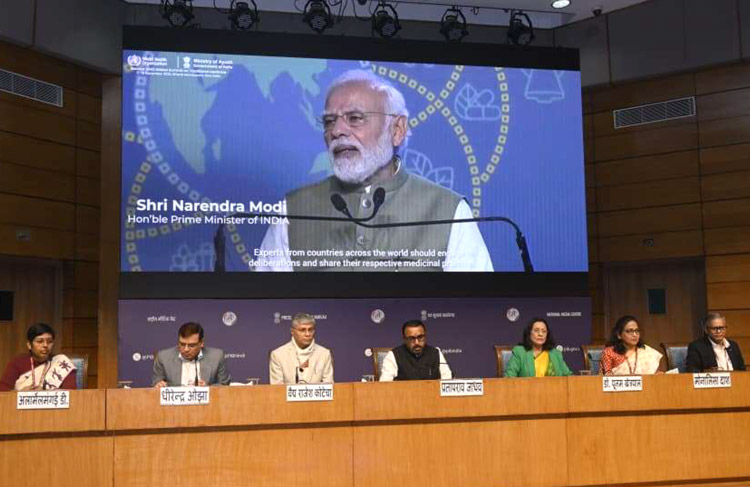
India formally began preparations for the 2nd WHO Global Summit on Traditional Medicine with a Curtain Raiser Press Conference organized by the Ministry of Ayush at the National Media Centre in New Delhi. The global event will take place from 17–19 December 2025 at Bharat Mandapam.
Union Minister of State (Independent Charge) for Ayush, Shri Prataprao Jadhav, expressed his delight that India will once again host this major international gathering, following the inaugural edition conducted in Gujarat in 2023. He noted that the upcoming summit represents a significant step toward strengthening the worldwide integration of traditional healing systems, echoing India’s ethos of “Sarve Bhavantu Sukhinah, Sarve Santu Niramayah.”
The Minister highlighted this year’s theme—“Restoring balance: The science and practice of health and well-being”—and shared that the summit is expected to attract Ministers, global health experts, researchers, industry stakeholders, and practitioners from more than 100 countries.
Shri Jadhav also announced a special side event dedicated to Ashwagandha, one of India’s most widely researched medicinal plants. The session will explore its significance in traditional health frameworks as well as modern scientific practices.
Underscoring India’s pioneering role in traditional medicine, he stated that systems such as Ayurveda, Yoga & Naturopathy, Unani, Siddha, Sowa-Rigpa, and Homoeopathy have been trusted by communities for centuries and continue to gain worldwide recognition. He pointed to the establishment of the WHO Global Traditional Medicine Centre in Jamnagar, Gujarat, as a strong symbol of global confidence in India’s traditional knowledge.
The Minister applauded the Ministry of Ayush and WHO teams for their sustained collaboration in organizing the summit and acknowledged the media’s contribution in deepening public understanding of traditional medicine. He further shared that the Prime Minister of India is expected to attend the closing ceremony.
Dr. Poonam Khetrapal, Regional Director Emeritus of WHO South-East Asia Region and Senior Advisor on Traditional Medicine to the WHO Director-General, described the upcoming summit as a pivotal moment for global health cooperation. She noted that participation from over 100 nations will help shape a 10-year strategy for integrating traditional, complementary, integrative, and Indigenous medical systems into national healthcare frameworks. Emphasizing the widespread use of traditional medicine globally, she stressed the need for stronger research, innovation, and regulatory mechanisms.
A focused side event, “Ashwagandha: From Traditional Wisdom to Global Impact – Perspectives from Leading Global Experts,” will be conducted from 17–19 December 2025. Hosted jointly by WHO-GTMC and the Ministry of Ayush, the program will unite top scientists, clinicians, and policymakers to assess contemporary research on Ashwagandha’s adaptogenic, neuroprotective, and immunological benefits. Safety, evidence-based use, and pathways to global acceptance of high-quality Ashwagandha products will be key areas of discussion.
Senior government officials—including Ayush Secretary Vaidya Rajesh Kotecha, PIB Principal DG Shri Dhirendra Ojha, and Ayush Joint Secretaries Ms. Alarmelmangai D and Ms. Monalisa Dash, along with Shri Satyajit Paul, Deputy Director General—were present at the launch event, which was also attended by Ministry representatives and the media.
The Curtain Raiser followed an Ambassadors’ Reception held earlier on 9–10 November 2025, where diplomats were briefed on the importance of India’s partnership with the WHO in the field of traditional medicine.
With this event, India officially begins the countdown to the 2nd WHO Global Summit on Traditional Medicine, strengthening its commitment to promoting holistic, inclusive, and sustainability-driven healthcare worldwide.
(Text and Photo source: (pib.gov.in)