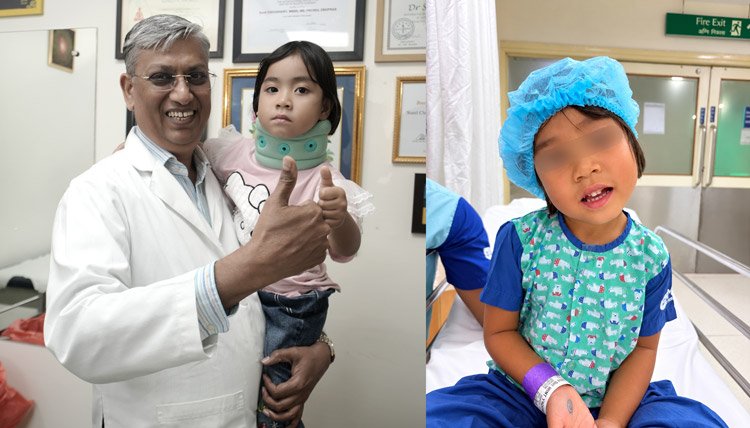
New Delhi, October 27, 2026: Doctors at Max Super Speciality Hospital, Saket, have successfully corrected a congenital neck deformity in a four-year-old girl from Myanmar through reconstructive surgery, restoring the normal position of her head and neck. The child, Baby Wint Yadanar Aung, was diagnosed with congenital torticollis, a condition in which a tight or shortened neck muscle causes the head to tilt to one side, with the chin turning in the opposite direction.
The child was first evaluated in May 2026 by a visiting medical team from Max Hospital, Saket, in Myanmar. Recognising the deformity, the team sought the expertise of Dr Sunil Choudhary, Chairman & Chief of Plastic Surgery at Max Super Speciality Hospital, Saket, New Delhi. Following a remote consultation in which he reviewed the child’s photographs and medical history, Dr Choudhary diagnosed congenital torticollis and advised the family on the available treatment options.
For the family, the condition was a source of growing concern, not only because of the visible neck tilt but also because of its impact on the child’s social experiences. The child was reportedly subjected to ridicule over her appearance, prompting her parents to seek a definitive solution. After being counselled about the condition and the possibility of surgical correction, the family travelled from Myanmar to India for treatment.
The surgical team identified a tight muscle on the right side of the child’s neck as the cause of the abnormal head posture. The procedure involved releasing the contracted muscle at both its upper and lower attachments, allowing the head and neck to return to a more natural alignment. The surgery successfully corrected the neck tilt.
Speaking about the case, Dr Sunil Choudhary, Chairman & Chief of Plastic Surgery, Max Super Speciality Hospital, Saket, said, “Congenital conditions that affect a child’s posture, facial appearance or physical function require careful evaluation, as their impact can extend well beyond the visible deformity. Congenital torticollis is one such condition. Depending on its severity and the child’s age, treatment may range from physiotherapy and stretching exercises to surgery when the muscle contracture persists. Timely assessment is important because a persistent head tilt can contribute to facial asymmetry and affect the child’s development. For us, the objective of reconstructive surgery is not simply to correct a deformity, but to help children achieve better function, support their development and grow up with greater confidence.”
The child recovered well after surgery and was discharged following the initial healing period. After 10 days of recovery, she travelled back to Myanmar and has been doing well.
Congenital torticollis can sometimes be identified in infancy through an abnormal head tilt or difficulty turning the neck in one direction. While many children respond to early conservative treatment, including physiotherapy, some may require surgical intervention if the contracture persists. Medical evaluation helps determine the appropriate treatment based on the child’s age, the severity of the condition and the response to earlier treatment.
The case underscores the importance of recognising congenital deformities early and ensuring access to specialised paediatric reconstructive care. For children, timely treatment can help address functional limitations and reduce the longer-term physical and psychosocial effects associated with visible deformities.
About Max Healthcare:
Max Healthcare Institute Limited (Max Healthcare) is one of India’s largest healthcare organizations. It is committed to the highest standards of clinical excellence and patient care, supported by latest technology and cutting-edge research.
Max Healthcare operates 21 healthcare facilities (6,100+ beds) with a significant presence in North India. The network consists of all the hospitals and medical centres owned and operated by the Company and its subsidiaries, partner healthcare facilities and managed healthcare facilities, which includes state-of-the-art tertiary and quaternary care hospitals located at Saket (3 hospitals), Patparganj, Vaishali, Rajendra Place, Dwarka, Noida and Shalimar Bagh in Delhi NCR and one each in Lucknow, Mumbai, Nagpur, Mohali, Bathinda, Dehradun, and Bhubaneswar, secondary care hospital in Gurgaon and medical centres at Noida, Lajpat Nagar and Panchsheel Park in Delhi NCR, and one in Mohali, Punjab. The hospitals in Mohali and Bathinda are under PPP arrangement with the Government of Punjab.
In addition to the hospitals, Max Healthcare operates homecare and pathology businesses under brand names Max@Home and Max Lab, respectively. Max@Home offers health and wellness services at home while Max Lab provides diagnostic services to patients outside the network.