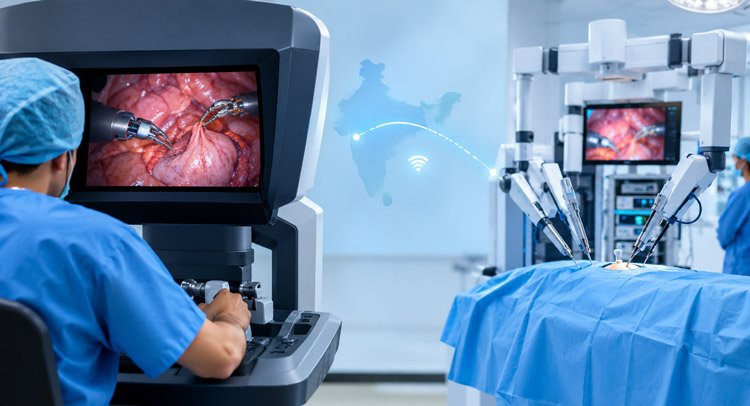
A patient in Andhra Pradesh has received specialised surgical care from a Delhi-based cancer surgeon without the surgeon travelling to the hospital. The procedure, performed remotely using an Indian-developed robotic platform, highlights the potential of telesurgery to improve access to advanced cancer treatment beyond major urban centres.
Dr Sudhir Rawal, Chief of Genito-Uro Oncology at Rajiv Gandhi Cancer Institute & Research Centre (RGCIRC), Delhi, operated from the institute while the patient was treated at a hospital in Puttaparthi, Andhra Pradesh. The procedure was a partial nephrectomy, in which the cancer-affected portion of the kidney is removed while preserving as much healthy tissue as possible.
The surgery used the SSI Mantra Surgical Robotic System, an indigenously developed technology. It was conducted as part of the Urological Society of India’s USI CARES initiative in Puttaparthi, which facilitates free surgical treatment while creating opportunities for urologists to exchange knowledge and expertise.
Access to experienced cancer surgeons remains a challenge for patients living far from specialised medical centres. Travel, accommodation expenses and time away from family can add to the burden of treatment. Telesurgery could help reduce these barriers by connecting patients with specialists in distant locations, provided the necessary clinical and technical infrastructure is available.
The concept gained international attention in 2001, when a surgeon in New York operated remotely on a patient in Strasbourg, France. However, high costs, technological constraints and limitations in high-speed connectivity initially restricted its wider adoption. Advances in surgical robotics and telecommunications have renewed interest in remote procedures.
“The significance of telesurgery lies in taking surgical expertise to the patient. This procedure shows how a surgeon at RGCIRC can work with a team in another state to deliver specialist cancer care to remote areas, where accessibility to high quality cancer care is still limited,” Dr Rawal said.
In robotic telesurgery, a surgeon controls robotic instruments from a remote console, transmitting commands to equipment at the patient’s location. Live video enables the surgeon to view the operating field, while a local clinical team provides patient support and manages care.
Successful implementation requires stable connectivity, minimal transmission delays, trained personnel and clear contingency plans to address technical failures or medical emergencies.
RGCIRC has been involved in providing clinical feedback during the development and evaluation of the SSI Mantra system. In 2022, the institute published findings from preliminary trials, documenting how surgical experience contributed to subsequent refinements in the technology.
In July 2024, RGCIRC also reported completing a telesurgery trial involving six procedures across kidney, bladder and gynaecological surgery. These experiences helped evaluate the feasibility of performing remote operations under controlled conditions.
Telesurgery may also create opportunities for specialist-led training and remote mentorship. Experienced surgeons can potentially guide teams at other hospitals, helping them develop skills and share clinical knowledge without requiring frequent travel.
“Telesurgery has an important role to explore in training and mentoring, alongside patient care. By connecting experienced specialists with teams elsewhere, we can share knowledge and support the development of surgical skills,” Dr Rawal said.
The latest procedure adds to RGCIRC’s efforts to assess Indian-developed robotic technology and explore new models of delivering specialised cancer care.
As the technology advances, its wider application will depend on rigorous clinical evaluation, dependable infrastructure, trained local teams and robust emergency protocols. Telesurgery could become a valuable complement to conventional surgical services, helping extend specialist expertise to patients who face geographical barriers to treatment.
(The above image is AI-generated and is for illustrative purposes only)