By Dr. Dilip M. Babu, Senior Consultant Nephrologist and Transplant Physician, Yashoda Hospitals, Hyderabad

Imagine two people holding the same lab report. Both have a creatinine value printed in the “normal” range, and both walk away relieved. One of them truly has healthy kidneys. The other has been quietly losing filtering capacity for years, and nothing on that page has told them so.
This is not a rare trick of statistics. It happens because kidneys are generous organs: they hide trouble well, stay silent for a long time, and a single blood number can’t speak for everything they do.
Why a “normal” creatinine can be falsely reassuring
Creatinine is a waste product that comes from the everyday wear and tear of your muscles. It floats in your blood, and healthy kidneys filter it out into urine. When filtering slows, creatinine tends to climb. Simple enough.
The catch is that creatinine depends on two things, not one: how well your kidneys clear it, and how much your body makes in the first place. That second part varies a lot from person to person.
- Low muscle mass means low creatinine production. An older adult, someone who has lost weight or muscle through illness, or a person with a very slight build can have a creatinine that looks comfortable even when filtration has dropped.
- High muscle mass does the opposite. A heavily muscled person or someone taking creatine supplements may show a higher creatinine without any kidney problem.
- Diet, hydration and medicines nudge the number too. A large meal of cooked meat, a hard workout the day before, dehydration, or certain drugs can all shift it temporarily.
- Kidney reserve is the quiet one. You can lose a sizeable share of kidney function before creatinine rises noticeably, so the number often lags behind the damage.
So creatinine isn’t useless. It simply isn’t a verdict on its own.
eGFR: a smarter number, but still an estimate
The estimated glomerular filtration rate (eGFR) takes your creatinine and combines it with your age and sex in a formula to estimate how many millilitres of blood your kidneys filter each minute. It is reported as mL/min/1.73 m². Current equations no longer use race as a factor.
Because it adjusts for some of creatinine’s individual variation, eGFR is the number doctors lean on to stage kidney disease:
| Category | eGFR | Meaning |
| G1 | 90 or above | Normal or high |
| G2 | 60–89 | Mildly decreased |
| G3a | 45–59 | Mild to moderate decrease |
| G3b | 30–44 | Moderate to severe decrease |
| G4 | 15–29 | Severely decreased |
| G5 | Below 15 | Kidney failure range |
Two things are worth knowing. First, eGFR drifts downward naturally with age, so a 70-year-old with a value in the 70s is not necessarily unwell. Second, a value of 60–89 does not by itself mean kidney disease; there must be another sign of damage. An eGFR that stays below 60 for three months or more, however, meets one of the criteria for chronic kidney disease (CKD).
It is still an estimate. In people with unusual muscle mass, those who are pregnant, very overweight, or acutely ill, creatinine-based eGFR can mislead. In such cases a doctor may add a cystatin C blood test, a protein that is less affected by muscle and diet, to sharpen the picture.
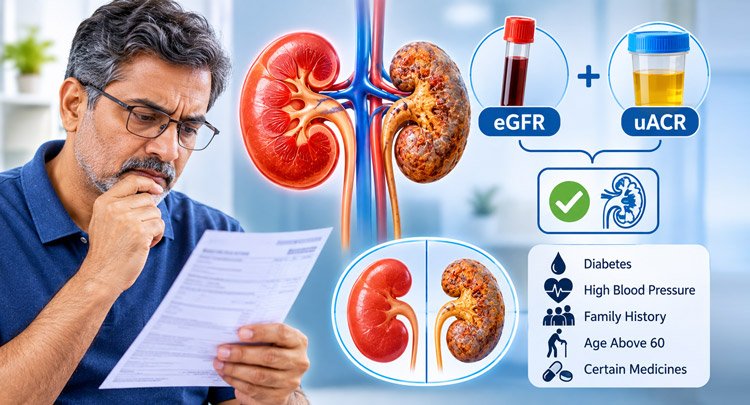
The test many people never get: urine albumin-to-creatinine ratio (uACR)
Here is the part that surprises people. Your eGFR measures how well the kidneys function. It does not tell you whether the filters are leaking.
Healthy kidneys keep albumin, a key blood protein, in the bloodstream. When the tiny filtering units are damaged, albumin starts slipping into the urine. This can happen early, sometimes years before eGFR falls. A kidney can be filtering at a normal rate and still be injured.
The uACR compares the albumin in a urine sample with the creatinine in the same sample, which corrects for how dilute or concentrated your urine happens to be. The usual categories are:
- A1: below 30 mg/g, normal to mildly raised
- A2: 30–300 mg/g, moderately raised
- A3: above 300 mg/g, severely raised
Laboratories sometimes report in mg/mmol instead (below 3 is A1), so always check the unit printed on your report before comparing numbers.
A single high result is not a diagnosis. Fever, a urinary infection, vigorous exercise, menstruation or a contaminated sample can all push uACR up temporarily. That is why doctors usually repeat it, often using a first-morning sample. Persistent albuminuria for three months or longer is what counts toward CKD.
A plain dipstick urine test can also hint at protein, but it can miss the smaller amounts that a uACR picks up. They are not interchangeable.
Why both tests belong together
Think of eGFR as a measure of how much work the kidneys are doing, and uACR as a check on how much damage is showing. Each can be abnormal while the other looks fine:
- Normal eGFR, raised uACR: filtration is still preserved, but the urine suggests early injury. This is the scenario a creatinine-only check completely misses.
- Reduced eGFR, little or no albumin: function is down, and the cause needs exploring. Age, medicines, past results and other conditions all matter.
- Both abnormal: this combination carries a higher risk and usually calls for closer monitoring, since someone with the same eGFR but more albumin leakage faces greater risk of progression and of heart disease.
This is why guidelines describe kidney health on two axes, a G category from eGFR and an A category from uACR. The pair tells a far fuller story than either number alone.
Who should specifically ask for these tests
Early CKD usually produces no symptoms. By the time swelling, fatigue, foamy urine, changes in urination or nausea appear, the disease is often well along. So testing is the only reliable way to catch it early. Consider asking your doctor about both eGFR and uACR if you have:
- Diabetes (yearly testing is generally advised)
- High blood pressure
- Heart disease
- A family history of kidney failure
- Long-term use of medicines that can strain the kidneys, such as regular painkillers of the NSAID type
- Age above 60, or a history of kidney stones, prostate enlargement or autoimmune illness
People of South Asian origin are also reported to carry a higher risk of kidney disease, so a conversation about regular screening is worthwhile.
Trends beat snapshots
One result is a photograph; several results are a film. An eGFR that has sat steadily around 74 for years tells a very different story from one that went 91, then 78, then 64 over the same period, even though all three values might look “acceptable” in isolation. A falling trend deserves attention long before a number crosses a dramatic threshold.
So keep your reports. Store them together, note the dates and units, and bring them to appointments. Your doctor’s ability to interpret a new result depends heavily on what came before it.
Practical steps before and after your test
Before testing
- Tell the clinician about every medicine and supplement, creatine included. Don’t stop prescribed medicines on your own.
- Follow the lab’s instructions on fasting and on avoiding cooked meat, if asked.
- Avoid hard exercise the day before, and stay normally hydrated. Chugging litres of water won’t fix anything and only affects the result briefly.
After an abnormal result
- Don’t panic and don’t label yourself. One abnormal value is a prompt for repeat testing, not a diagnosis.
- Ask what the result means for you, whether it should be repeated, and whether a uACR or cystatin C test would help.
- If CKD is confirmed, the goals are to slow progression: keep blood pressure and blood sugar well controlled, eat less salt, stay active, avoid smoking, and review medicines with your doctor. A nephrologist referral is sensible when the cause is unclear or kidney function is meaningfully reduced.
No food, drink or supplement can raise your eGFR in a reliable way, so be wary of anyone selling one.
Conclusion
A normal creatinine is good news, but it is a partial answer to a bigger question. Real reassurance about your kidneys comes from two tests read together, a blood-based eGFR and a urine uACR, and from watching how they behave over time. If you’re at risk, or simply haven’t been checked, ask for both. They are quick, inexpensive, and can catch a quiet problem while there is still plenty of kidney left to protect.
Dr. Dilip M Babu | MD (Internal Medicine), DM (Nephrology) | Senior Consultant Nephrologist and Transplant Physician, Yashoda Hospitals, Hyderabad
Dr. Dilip M Babu is a Senior Consultant Nephrologist and Transplant Physician at Yashoda Hospitals, Somajiguda, with 24 years of experience in the diagnosis and management of kidney disorders in adults and children. His clinical expertise covers a wide range of kidney conditions, including acute kidney injury, chronic kidney disease, glomerular diseases, and kidney complications associated with diabetes and hypertension.
He has specialised experience in kidney transplantation, including live and deceased donor transplants, and the management of complex renal conditions. His areas of expertise also include haemodialysis, peritoneal dialysis, plasmapheresis, continuous renal replacement therapy (CRRT), kidney biopsy and dialysis catheter placement. He also manages paediatric kidney disorders, including genetic and metabolic conditions.
Dr. Dilip completed his MBBS from Seth G.S. Medical College and K.E.M. Hospital, Mumbai, in 2000. He went on to pursue MD in Internal Medicine from Grant Medical College and J.J. Hospital, Mumbai, in 2004, followed by DM in Nephrology from Seth G.S. Medical College and K.E.M. Hospital in 2008.
His special interests include transplant nephrology, interventional nephrology, critical care nephrology, and the treatment of complex kidney diseases.