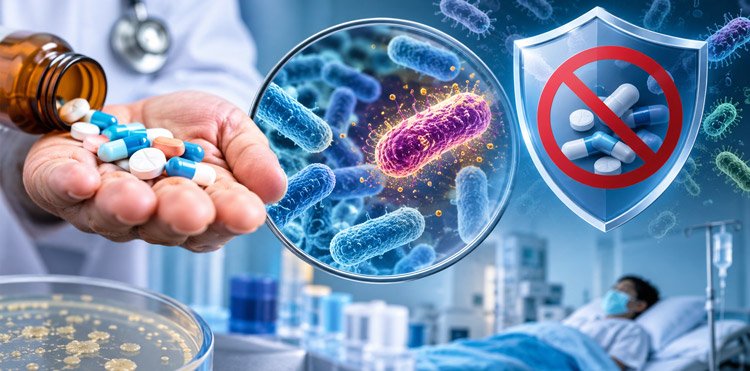
By Dr. K. Seshi Kiran, Senior Consultant General Physician, Yashoda Hospitals, Hyderabad

Here’s something most of us never think about. We catch a nasty infection, take a course of tablets, and a few days later we’re back on our feet. It just works, so we stop noticing. But in hospitals across India and around the world, that quiet assumption is starting to crack. Doctors reach for the usual antibiotic and watch it do very little. Then they have to try something else, something costlier and harsher. And sometimes there isn’t a something else.
When a Routine Fix Stops Being Routine
Antibiotics changed what an infection meant. Before them, a gardening scratch or a bad sore throat could turn deadly. Afterwards, surgeries, transplants, chemotherapy and caesarean sections became far safer, because infection could be kept in check. Alexander Fleming, who discovered penicillin in 1928, saw the catch early. When he accepted his Nobel Prize in 1945, he warned that careless use could breed resistant bacteria.
Eighty years on, the numbers back him up. The World Health Organization (WHO) says about one in six lab-confirmed bacterial infections worldwide in 2023 resisted antibiotics. In South-East Asia it was closer to one in three. One clarification, since it trips people up: your body doesn’t become resistant. The bacteria do.
What India’s Latest Numbers Say
The Indian Council of Medical Research (ICMR) recently released its 2025 antimicrobial resistance surveillance report, and it doesn’t make comfortable reading. E. coli and Klebsiella pneumoniae, two bugs behind urinary tract infections, pneumonia and bloodstream infections, are now shrugging off several antibiotics doctors have leaned on for years. Carbapenems, the powerful reserve drugs, are losing ground too, mostly against bacteria linked to hospital infections.
The report also did something new. It pulled in data from 34 secondary-care hospitals, and the finding there was blunt: resistance to third-generation cephalosporins is very high even outside the big specialised centres. Dr Kamini Walia, who heads ICMR’s Descriptive Research Division, says the team expected these drugs to hold up better. They didn’t. Her view is that we’re already at the point where routine infections are getting harder to treat.
How Bacteria Get Around Our Medicines
Bacteria multiply quickly, and every so often a copy comes out slightly different. When an antibiotic floods in, most of them die. The odd one with a lucky change survives, and before long its descendants are everywhere. Over time they’ve developed some clever defences:
- Enzymes that chop the drug apart before it can act (ESBLs and carbapenemases are the well-known ones)
- Tiny pumps that push the antibiotic straight back out
- A modified outer layer, so the drug can’t get inside
- A reshaped target, leaving the medicine nothing to latch onto
The unnerving part is that bacteria trade these tricks. Resistance genes can hop between them on small loops of DNA, even across species. So a germ that has never met a particular antibiotic can still turn up already immune.
Why We Keep Handing Them the Advantage
Evolution does the inventing. We supply the pressure. A few of the usual culprits:
- Antibiotics for viral illness. Colds, most viral fevers and plenty of diarrhoeal infections don’t need them. Taking them does nothing for you, yet it still nudges the bacteria in your body to adapt.
- Self-medication. Buying antibiotics over the counter, guessing the dose, or stopping halfway because you feel better.
- Farming. Antibiotics given to poultry and livestock to speed growth or ward off disease can produce resistant bacteria that reach us through food, water and soil.
- Poor hygiene and sanitation. Weak handwashing, crowded wards, untreated hospital waste.
- A thin pipeline. New antibiotics are expensive to develop and don’t earn much, so few companies bother.
WHO figures show only about 53% of global antibiotic use comes from the “Access” group, the first-choice drugs for common infections. The target for 2030 is at least 70%.
The Hardest Hit: Hospital Wards and Newborns
Hospitals bring together very sick patients, catheters, ventilators and heavy antibiotic use. For resistant bacteria, that’s about as good as it gets. When first- and second-line drugs fail, doctors move on to third-line options. These cost more, can work less well, and tend to bring more side effects.
Newborns are a particular worry. ICMR’s report names Klebsiella pneumoniae as the most common cause of bloodstream infections in newborns, with troubling resistance patterns. Nationwide data from neonatal intensive care units is still being analysed, and treatment protocols may need adjusting once the picture is clear. For any parent waiting outside a NICU, that isn’t an abstract statistic.
How to Tell When an Antibiotic Isn’t Doing Its Job
A resistant infection often looks like an ordinary one at first. The giveaway is how it behaves. Go back to your doctor if you notice:
- No improvement after two or three days of treatment
- Symptoms getting worse, or new ones appearing
- A fever that lingers or returns
- Infections that keep coming back, like repeat UTIs
- Skin abscesses that won’t settle
Don’t swap medicines or repeat an old course on your own. A culture test, a different drug or specialist care may be what’s needed, and the sooner the better.
What Doctors and Hospitals Can Do
There’s no single fix, but experts keep pointing to the same handful of habits.
- Know your local picture. Hospitals can keep an antibiogram, a simple record of which antibiotics still work against common bacteria in that particular facility. A district hospital, a referral centre and an ICU can look very different.
- Test early. Quick diagnostics help doctors move from educated guesswork to the right drug sooner. A seriously ill patient may need broad treatment before results arrive, which is fine. But once the lab report is in, the treatment should be reviewed and narrowed where possible.
- Match the drug to the site. What clears a simple bladder infection may not suit a kidney, bloodstream or brain infection.
- Build stewardship into the system. Infection control and antimicrobial stewardship committees, even in smaller hospitals, help keep powerful drugs for the cases that truly need them. ICMR’s expert would like to see stewardship made compulsory in every hospital, along with training for prescribers.
- Prevent infection in the first place. Vaccines against influenza, typhoid and pneumococcus mean fewer infections and fewer prescriptions.
What You Can Do
It’s easy to assume this is a problem for governments and hospital administrators. It isn’t, quite. Small choices add up.
- Don’t pressure your doctor for antibiotics when you have a cold or viral fever.
- Skip self-medication, and never buy antibiotics without a prescription.
- Take the course exactly as prescribed. Some infections now need shorter courses, so follow your own prescription rather than a rule of thumb.
- Don’t share tablets, and don’t keep leftovers in a drawer “just in case”.
- Wash your hands, handle food safely and keep vaccinations current.
- If you’re unsure why an antibiotic was prescribed, ask. That’s a perfectly normal question.
Is There Any Good News?
Some, yes. Researchers are working on bacteriophages (viruses that attack bacteria), antimicrobial peptides, microbiome-based treatments and gene-editing tools that switch off resistance genes. Faster tests are shrinking the gap between suspecting an infection and treating it properly.
Policy is shifting too. New WHO data released ahead of World AMR Awareness Week (18–24 November) shows 173 countries now have national AMR plans, up from 79 in 2017. The catch? Only 22% report having both the funding and full implementation, and just 36% have a national reference laboratory able to test the key bacteria and fungi. A plan on paper doesn’t protect anyone in a hospital bed.
One Last Thought Antibiotics were never a permanent win over bacteria. They’re a shared resource, and every unnecessary tablet takes a little out of the account our children will need. So the next time a prescription lands in your hand, or you’re tempted to ask for one, think of it that way. Using it well is how we keep it working.
Dr. K. Seshi Kiran is a Senior Consultant General Physician at Yashoda Hospitals, Somajiguda, Hyderabad, with 22 years of experience in General Medicine and Geriatrics. He holds an MD in General Medicine and has received a Gold Medal in MBBS and a University Gold Medal in MD.
His clinical expertise includes the diagnosis and management of infectious diseases, HIV, hypertension, sepsis, critical care and complex medical conditions. He also has a special interest in geriatric medicine, focusing on the health needs of older adults and improving their functional quality of life.
Dr. Seshi Kiran provides comprehensive care for older patients dealing with multiple chronic conditions, unexplained muscle or weight loss, acute deconditioning and delirium. His areas of practice also include preventive geriatrics, geriatric oncology and medication optimisation for patients taking multiple medicines.
With experience in managing complex infections and critical illnesses, he focuses on timely diagnosis, appropriate treatment and continuity of care. His clinical approach also emphasises healthy ageing, prevention of complications and maintaining independence and quality of life among elderly patients.