By Dr Abhishek Barli, Sr. Consultant Orthopaedic Surgeon, Yashoda Hospitals.
When patients learn they may need a joint replacement, the questions come quickly. Will it ease the pain? How long will recovery take? Lately, many also ask about “robotic surgery” and “AI-planned” procedures, and whether they should be asking for them.
The honest answer is that these tools are useful, but they are not magic. They help the surgeon plan and carry out the operation with more precision. Whether they improve life years later is still being studied.
Why People Need Joint Replacement
Joint replacement is usually considered when arthritis or injury has damaged a joint so much that daily life becomes hard. Pain may disturb sleep. Walking, climbing stairs, or getting up from a chair may feel like a struggle.
For many people, a well-done replacement brings back comfort, movement, and independence. That is the goal of every technique, whether it is traditional or technology-assisted.
What “Smarter” Joint Replacement Means
In simple terms, it means the care team uses more information at every stage. That includes planning before surgery, guidance during it, and tracking recovery afterwards.
Two technologies do most of the work:
- AI (artificial intelligence) is software that studies scans and health information to find patterns. It supports planning and prediction.
- Robotic systems are surgeon-controlled tools that help carry out the plan, such as preparing the bone and positioning the implant.
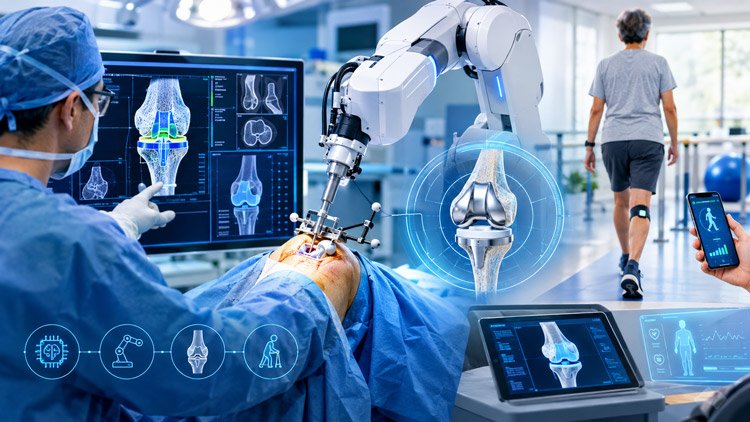
They are different things, and they work together. AI helps with thinking and planning. The robotic arm helps with doing.
Before Surgery: How AI May Help Planning
Traditionally, planning depended on the surgeon’s reading of X-rays and their experience. That experience still matters a great deal. AI simply adds another layer of information.
- It can study a CT or MRI scan and build a 3D model of the joint.
- It can help measure how the bones are aligned and suggest the implant size and position.
- It can estimate practical details, such as how long a patient may need to stay in hospital, based on data from many earlier patients.
For the patient, this can mean a plan that fits their own anatomy more closely, rather than a one-size-fits-all approach.
There is a limit worth knowing. Many AI tools have been tested mostly on past records from a single hospital. They may not work equally well for every group of patients. That is why AI is best seen as a helper for the surgeon’s judgement, not a replacement for it.
During Surgery: What the Robot Actually Does
A common worry is, “Will a robot operate on me?” That is not how it works. In current joint replacement, the surgeon stays in control throughout. Regulators describe these systems as computer-assisted devices that remain under the direct control of trained doctors.
Here is how it generally works:
- Plan. A scan is used to create a 3D plan for the joint.
- Guide. During surgery, the system tracks the position of the bone and the instruments.
- Protect. Many systems use “boundaries.” If the surgeon moves outside the planned area, the system resists or stops the tool. This helps protect nearby soft tissue.
- Confirm. The surgeon checks the plan and adjusts it as needed.
Some systems need a CT scan before surgery. Others skip it and map the joint during the operation. Each approach has trade-offs, such as radiation from the scan, set-up time, and cost. The surgeon can explain which one is used and why.
What May Change for Patients, and What Is Still Uncertain
Patients deserve a clear and balanced picture.
What is well supported
- Robotic assistance helps place implants closer to the planned position.
- It reduces “outliers,” meaning implants that end up far from the intended alignment.
- Some reports point to less tissue damage, shorter hospital stays, and a quicker return to daily activity.
What is not yet proven
- Better accuracy has not consistently led to better long-term results.
- Data so far have not clearly shown better comfort, higher satisfaction, or longer implant life compared with conventional surgery.
- Larger trials and long-term records are still needed.
So, what does this mean in practice? A robotic or AI-assisted operation is not automatically “better” or “worse.” It is another way to do the same surgery, with some added precision. A conventional operation by an experienced surgeon remains a safe and sound choice for many people.
After Surgery: Technology Can Support Recovery
Recovery is a big part of success, and technology is helping here too.
- Rehabilitation apps. Smartphone programs can guide exercises, send reminders, and alert the care team if recovery seems slow.
- Wearable sensors. These can measure movement and walking patterns during recovery.
- Virtual reality (VR). Some rehab programs use it for guided exercises. Surgeons also use it to practise procedures safely.
- Smart implants. These carry tiny sensors that could measure movement or load. This is still early, with open questions about battery life, data safety, and long-term reliability.
- Digital twins. This is a virtual model of a joint used to predict how it may perform. It is at the research stage and not part of routine care.
None of this replaces the patient’s own effort. Following the physiotherapy plan, moving as advised, and attending follow-up visits remain the biggest drivers of recovery.
When to Seek Medical Advice
Whatever method is used, a patient should contact their doctor promptly after surgery if they notice any of these:
- Increasing pain that does not settle with prescribed medicine
- Redness, warmth, or discharge from the wound
- Fever
- New swelling or pain in the calf
- Sudden breathlessness or chest pain (seek emergency care)
The Bottom Line
AI and robotics are making joint replacement more planned, more precise, and more data-informed. That is real progress, and the case for better accuracy is solid. But better accuracy does not automatically mean a better life outcome, and that part is still being proven.
For patients, what matters most is not the technology alone. It is a clear diagnosis, an experienced surgeon, a plan that suits the body, and steady rehabilitation. Technology is a useful addition to that foundation, not a replacement for it.

Dr Abhishek Barli
MBBS, MS (Ortho) | Sr. Consultant, Robotic Joint Replacement, Trauma & Arthroscopic Surgeon, Specialised in Robotics Yashoda Hospitals, Somajiguda, Hyderabad
Dr Abhishek Barli is an orthopaedic surgeon with 21 years of experience, focusing on joint replacement, complex trauma and arthroscopy. He is trained in robotic-assisted techniques and sees patients at Yashoda Hospitals, Somajiguda.
He completed his MBBS in 2003 and MS in Orthopaedics in 2008 at JJM Medical College, Davanagere, Karnataka. He worked as a Registrar at the Sanjay Gandhi Institute of Trauma and Orthopaedics and completed a Joint Replacement Fellowship at Laud Clinics, Mumbai, in 2010. He later served as a Consultant at Global Hospitals, Bangalore, and as Senior Joint Replacement, Complex Trauma and Arthroscopy Surgeon at Srikara Hospitals, Secunderabad, from 2015 to 2025.
His areas of practice include robotic total knee replacement, primary and revision knee replacement, hip and shoulder replacement, knee and hip arthroscopy, ACL and PCL reconstruction, deformity correction, and pelvic-acetabular and limb trauma surgery. He is a member of the Telangana Medical Council and speaks English, Hindi, Telugu and Kannada.