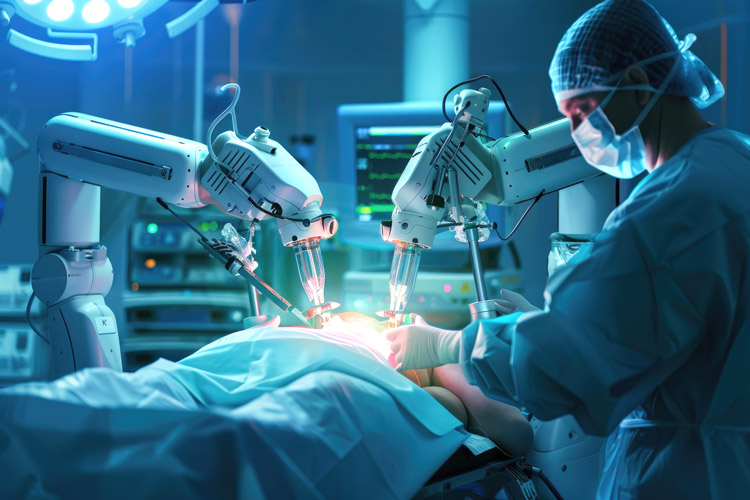
New Delhi’s premier medical institute has reached a significant milestone in surgical care. The All India Institute of Medical Sciences (AIIMS), Delhi announced on Tuesday that it has successfully completed more than 1,000 robotic-assisted operations over the past 13 months.
The robotic surgery programme was launched just over a year ago at AIIMS’s Department of Surgical Disciplines to tackle complex surgical conditions. Since then, the advanced robotic system has been used across a wide range of procedures — from hepatobiliary operations like pancreatic duodenectomy to intricate cancer-related resections, kidney transplants, and minimally invasive endocrine tumour removals.
AIIMS highlighted that the integration of such cutting-edge technology into its General Surgery unit marks one of the first times a government hospital in India has adopted this level of robotic capability in that discipline. “This marks a transformative milestone, as the department becomes one of the first General Surgery units in a government hospital in India to acquire such cutting-edge technology,” the institute said in an official statement.
Officials emphasized the impact this has on public healthcare access. While private facilities in major cities have used robotic systems, particularly in urology and gynaecology, for many years, government-run institutions have been slower to adopt them. AIIMS’s efforts are aimed at narrowing that gap and extending advanced surgical options to patients from varied socio-economic backgrounds.
“The adoption of the surgical robot represents a crucial development in making minimally invasive, highly precise surgeries accessible to a larger population, setting a benchmark for public healthcare in India,” the institute added.
Teaching and training are also key parts of AIIMS’s robotics programme. More than a hundred surgical residents are enrolled in the department at any time, and exposure to robotic procedures is now part of their hands-on learning. “Successful installation of the system will provide our resident doctors ample opportunity to get trained on this latest technology during their residency period,” said Professor Sunil Chumber, Head of the Department. “This positioned our training curriculum on a par with any of the renowned medical institutes of the world.”
Robotic surgery brings several patient benefits, including smaller incisions, less blood loss, shorter hospital stays, and quicker recovery. The technology also offers enhanced 3D visualization and precision through robotic arms — advantages that are especially valuable for delicate operations in tight anatomical spaces, such as complex colorectal, esophageal, and pancreatic surgeries.
(Above image is only for representational purpose)