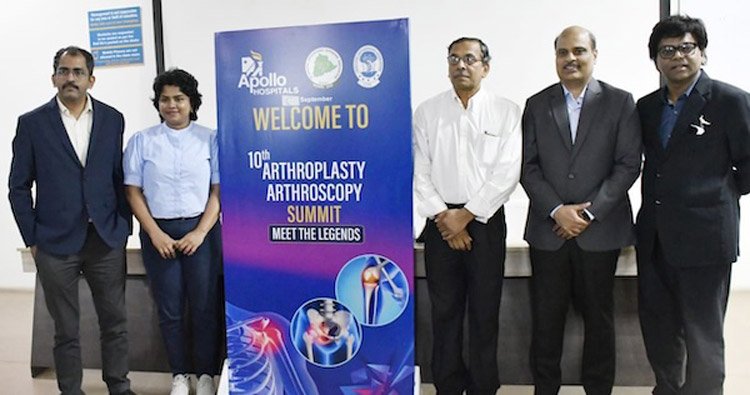
More than 250 orthopaedic surgeons from across India gathered in Hyderabad for the 10th Arthroplasty Arthroscopy Summit (AAS) 2026, organised by Apollo Hospitals, Secunderabad, on September 6.
Held at the Apollo Institute of Medical Sciences and Research, Jubilee Hills, the one-day meeting was conducted under the aegis of the Telangana Orthopedic Surgeons Association (TOSA) and the Twin Cities Orthopedic Society (TCOS).
The summit brought together experienced specialists and younger orthopaedic professionals to review complex cases, discuss advances in treatment and assess how emerging techniques can be applied in everyday clinical practice.
The programme covered a broad range of specialties, including joint replacement, arthroscopy, sports injuries, joint preservation, cartilage repair, spine surgery, trauma, periprosthetic joint infections, shoulder and elbow surgery, foot and ankle disorders, orthopaedic oncology and regenerative orthopaedics.
Dr. Mithin Aachi, Course Director of AAS and Senior Orthopedic and Joint Replacement Surgeon at Apollo Hospitals, Secunderabad, led the summit. Dr. N. Somasekhar Reddy, Organising Chairman of AAS and Senior Orthopedic and Joint Replacement Surgeon at Apollo Hospitals, Hyderabad, also played a key role in the programme.
Evidence Behind Robotic Surgery
Robotic-assisted joint replacement was one of the major topics discussed. Experts acknowledged that robotic platforms can improve surgical planning, precision and consistency. However, the discussions also stressed that technological advantages need to be assessed against long-term patient outcomes and cost-effectiveness before being considered clinically valuable.
The role of intra-articular injections and platelet-rich plasma (PRP) in osteoarthritis was another important area of discussion. Participants highlighted that PRP should not be regarded as a cure or as a proven cartilage-regeneration treatment for severe osteoarthritis. In advanced joint disease, its benefits may be limited or temporary.
Emerging Orthopaedic Approaches
The scientific sessions also reviewed newer approaches in ligament and joint treatment. These included the use of synthetic ligaments and internal bracing for selected anterior cruciate ligament (ACL) injuries, along with cell-based therapies being explored for knee osteoarthritis.
Advances in shoulder arthroplasty were also examined, with specialists discussing appropriate patient selection, available evidence, limitations and the need for longer-term outcome data.
Keeping Innovation Patient-Centred
The summit highlighted the importance of separating established treatments from emerging technologies that still require stronger clinical evidence. Discussions repeatedly focused on the role of scientific evidence, surgical expertise, appropriate patient selection and clinical value when evaluating new orthopaedic interventions.
AAS 2026 provided a platform for orthopaedic specialists to exchange knowledge and critically assess both established and emerging treatments. The discussions reinforced that innovation in orthopaedics must ultimately be measured by meaningful patient outcomes, safety and long-term clinical value.
(Photo courtesy: apollohospitals.com)