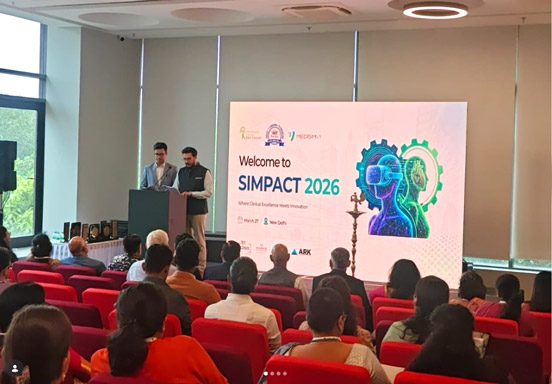
New Delhi hosted SIMPACT 2026, a national symposium dedicated to advancing healthcare training through simulation and competency-based education. The event was jointly organized by the Healthcare Sector Skill Council (HSSC), the SET Facility at AIIMS Delhi, and MediSim VR.
Bringing together policymakers, educators, clinicians, and simulation specialists, the symposium explored the growing role of immersive tools such as artificial intelligence (AI) and virtual reality (VR) in improving clinical skills and strengthening India’s healthcare workforce.
Held at the HSSC campus, the program included keynote sessions, panel discussions, and a live demonstration at the Advanced Technology Centre (ATC) Lab. Participants engaged with VR-based training modules designed to provide safe, repeatable environments for developing clinical expertise.
The event was attended by key dignitaries including Dr. Ambuj Roy, Professor of Cardiology and Head of SET Facility at AIIMS Delhi, and Dr. V N Mahalakshmi, Vice Chancellor of Santosh Deemed-to-be-University. Both speakers highlighted the growing importance of simulation in modern medical education. Dr. Manish Honwad, Surgeon Rear Admiral and Commanding Officer at INHS Asvini, joined as Guest of Honor and shared insights on scaling skill development across civilian and defense healthcare systems.
The speaker panel featured Ashish Jain, CEO of HSSC; Dr. Rashmi Ramachandran of AIIMS Delhi; Dr. Dinker Pai of Mahatma Gandhi Medical College; and Dr. Adith Chinnaswami, Organizing Secretary of SIMPACT 2026 and Co-founder of MediSim VR.
Additional perspectives came from experts in nursing, training, and healthcare education, including Dr. Rajesh Kumar Sharma, Dr. Lekha Viswanath, Col. Binu Sharma, Dr. Anu Gauba, Ms. Ekta Malik, Ms. Robia Chacko, Ms. Anshu Verma, and Mr. Unnikrishnan.
Key discussions revolved around integrating simulation into competency-based medical and nursing education, bridging the gap between infrastructure and measurable outcomes, and expanding access to advanced simulation technologies across India.
With healthcare education rapidly evolving, simulation-based training is emerging as a critical tool. AI-enabled platforms allow professionals to practice procedures, enhance decision-making, and manage complex scenarios without patient risk, leading to improved readiness and safety.
Ashish Jain, CEO, Healthcare Sector Skill Council, underscored the role of technology in workforce development, “As India expands its healthcare delivery systems, maintaining consistent training standards becomes critical. Simulation and immersive technologies offer scalable solutions to strengthen skill development and workforce readiness.”
Dr. Ambuj Roy added, “Simulation enables clinicians to rehearse complex procedures and critical scenarios without patient risk. Its integration into medical education strengthens preparedness, team coordination, and patient safety.”
Dr. V N Mahalakshmi emphasized, “Simulation is not a substitute for clinical experience. It enables healthcare professionals to learn new skills and refine existing ones in a zero-risk immersive environment, ultimately improving patient care. Platforms like SIMPACT play a critical role in building awareness and enabling the structured adoption of advanced simulation training across healthcare education.”
Dr. Manish Honwad noted, “In the armed forces, we rely on simulation to prepare for high-risk, high-stakes situations where there is no margin for error. Healthcare operates under similar pressures. Integrating technologies such as virtual reality into medical training ensures professionals are better equipped, more confident, and ready to respond effectively when it matters most.”
Dr. Adith Chinnaswami highlighted, “Simulation creates a pathway between theoretical knowledge and clinical practice. With immersive technologies such as virtual reality, learners can repeatedly practice procedures and decision-making until competency is achieved, significantly improving training quality and consistency.”
SIMPACT 2026 reflects a broader push toward collaboration between academia, industry, and skill development bodies to modernize healthcare training and build a future-ready workforce in India.
As India’s healthcare sector continues to expand, initiatives like SIMPACT 2026 underscore the urgent need for scalable, technology-driven training solutions. By promoting simulation-based learning and cross-sector collaboration, the symposium marks a significant step toward building a more skilled, confident, and future-ready healthcare workforce.
(Photo courtesy: instagram/medisimvr)