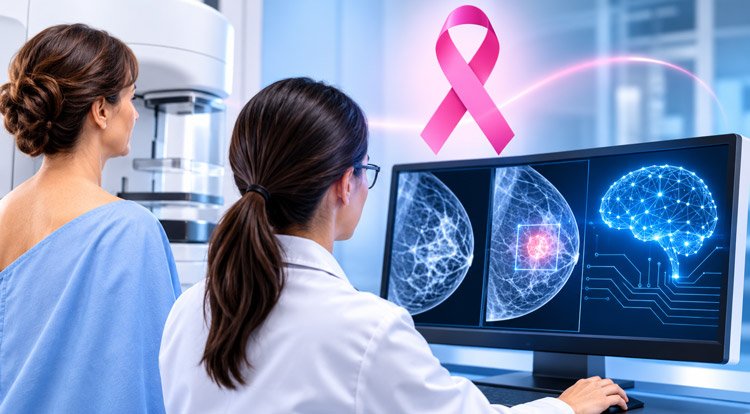
The United Kingdom is preparing to assess whether artificial intelligence can make breast cancer screening more efficient, with a major NHS-led study set to involve nearly 700,000 women.
The EDITH (Early Detection using Information Technology in Health) trial has received more than $13 million in government funding and will run for three years. Supported by the National Institute for Health and Care Research (NIHR), the study will examine whether AI can safely assist in interpreting mammograms and reduce the workload of breast radiologists.
Under the UK’s current screening system, two radiologists independently review each mammogram. The trial will investigate whether AI could eventually take over one of these reading roles without compromising screening accuracy.
Recruitment has begun at Cambridge University Hospitals, among the first 30 participating sites, with additional centres expected to join in the coming months.
The NHS invites women aged 50 to 71 for breast screening every three years. Around 2.1 million women undergo mammography annually, helping prevent an estimated 1,300 deaths each year.
Although mammogram interpretation requires considerable clinical time, fewer than 1% of screening examinations reveal signs of cancer. AI could potentially help specialists manage the large volume of scans, including those that show no abnormalities.
The NHS has already tested four AI systems for use in the study. However, all final clinical decisions will remain with qualified NHS professionals.
Hannah Maybour, head of public affairs at Breast Cancer Now, said the trial could help address staffing pressures if AI-assisted screening proves as safe and effective as the existing approach.
She noted that reducing the need for two specialists to review every scan could release valuable clinical time and support breast screening services.
The study will not alter routine screening appointments. Women receiving invitations will be provided with information about the trial and can opt out if they do not wish to participate.
NIHR chief executive Professor Lucy Chappell said the research would bring together scientists, NHS professionals and women from diverse backgrounds to establish whether AI could improve cancer detection and diagnosis.
The Royal College of Radiologists (RCR) has welcomed the study’s potential but cautioned that it will not resolve the UK’s immediate shortage of breast radiologists. More than one-fifth of the workforce is expected to retire by 2030.
RCR President Dr. Stephen Harden said: “This trial has real potential to free up radiologists’ time, but it won’t be a quick fix to the immediate need for more radiologists to ensure patients can get prompt answers about their health. We look forward to seeing the results of the trial.”
The EDITH trial could provide important evidence on how AI may support large-scale breast cancer screening. Its findings will help determine whether the technology can improve efficiency while maintaining the safety and reliability of human-led clinical care.
(The above image is AI-generated and is for illustrative purposes only)