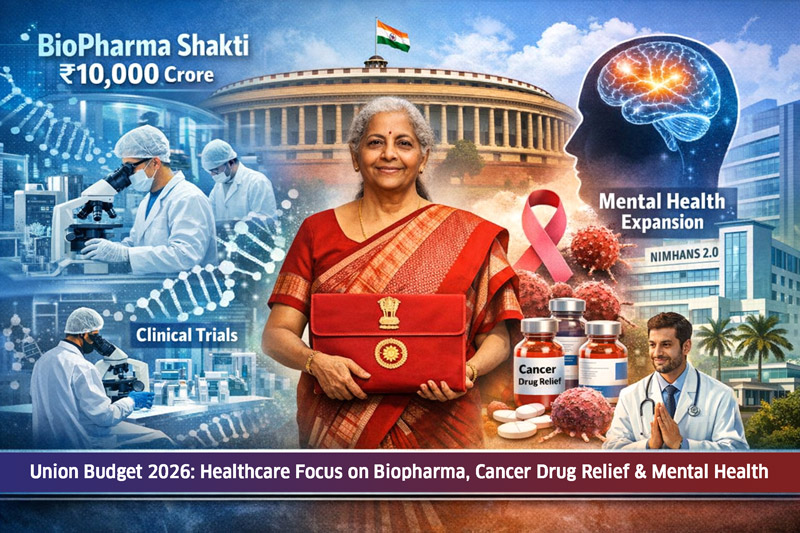
Healthcare and pharmaceuticals emerged as a major focus area in the Union Budget 2026, presented by Finance Minister Nirmala Sitharaman in Parliament on 1 January 2026, with targeted measures aimed at strengthening biopharma manufacturing, research ecosystems, workforce development and patient affordability.
A key highlight of the Budget was the announcement of ‘BioPharma Shakti’, a new national mission backed by an allocation of Rs 10,000 crore over five years. The programme is designed to position India as a global manufacturing hub for biologics and biosimilars while reducing reliance on imports.
Presenting the Budget, Sitharaman said the initiative would enhance domestic capacity in advanced therapies for conditions such as cancer, diabetes and autoimmune diseases, while encouraging high-value manufacturing and innovation-led growth.
To support the biopharma push, the government proposed the establishment of three new National Institutes of Pharmaceutical Education and Research (NIPERs) and the modernisation of seven existing institutions. These upgrades aim to reinforce advanced drug research, regulatory science capabilities and the availability of skilled professionals across the pharmaceutical sector.
In a move to accelerate drug discovery and development, the Finance Minister announced plans to create a national network of 1,000 accredited clinical trial sites. The initiative is expected to improve access to innovative therapies for patients while enhancing India’s attractiveness as a global destination for clinical research.
Mental healthcare received renewed emphasis in the Budget with the government proposing to expand national-level infrastructure. A second campus of the National Institute of Mental Health and Neurosciences (NIMHANS) will be developed as part of this effort.
In her Budget speech, Sitharaman stated that NIMHANS 2.0 would be established in North India, Ranchi and Tezpur, serving as regional centres for mental health treatment, education and neurosciences research.
While no separate budgetary allocation for mental health programmes was announced, funding will continue through existing channels, including institutional grants, the National Mental Health Programme and related healthcare initiatives.
The Budget also outlined steps to expand the allied healthcare workforce through the creation of new training institutions across multiple disciplines. The initiative aims to develop a pool of multi-skilled professionals, particularly to address service gaps in tier-2 and tier-3 cities.
To strengthen India’s position in global healthcare services, the government proposed setting up five regional medical tourism hubs in collaboration with state governments and the private sector. These hubs will integrate modern medical services with AYUSH-based therapies, creating comprehensive care destinations.
Additional measures include upgrading drug testing laboratories and reinforcing quality standards across pharmaceuticals and traditional medicine systems to ensure patient safety and global regulatory compliance.
Significant relief was announced for cancer patients with the government fully exempting basic customs duty on 17 critical cancer medicines.
In her Budget address, the Finance Minister said that many of these oncology drugs are imported and constitute a major share of treatment costs. The exemption is expected to reduce the financial burden on patients undergoing long-term cancer therapy.
Imported cancer drugs often attract high customs duties, which substantially increase retail prices. The exemption is likely to improve treatment affordability and continuity for patients and families.
Support for Rare Disease Treatments
Alongside oncology medicines, the Budget extended customs duty exemptions to therapies for seven additional rare diseases. This applies to personal imports of medicines, medical foods and specialised treatments that are not manufactured in India.
Mixed Industry Reactions
Speaking on medical tourism and integrated care, Abhay Soi, Chairman and Managing Director of Max Healthcare, said “the plan to develop regional medical hubs comes at an opportune time as India strengthens its position in global medical value travel. He explained that combining treatment, education, research, AYUSH systems and post-treatment rehabilitation reflects the growing demand for comprehensive, end-to-end care among patients from India and overseas.“
Highlighting the role of collaboration, Soi said “partnerships between the public and private sectors will be central to making these hubs effective. He noted that the healthcare industry is well equipped to support the initiative through clinical expertise, advanced technology and efficient operations, while also creating new jobs for doctors and allied healthcare professionals and driving innovation and skill enhancement.
Welcoming the Budget, Dr Ashutosh Raghuvanshi, Managing Director & CEO, Fortis Healthcare, said the proposals reflect India’s commitment to healthcare growth.
“The Rs 10,000-crore BioPharma Shakti initiative, expansion of NIPERs and the proposed national clinical trial network will strengthen India’s capabilities in biologics and biosimilars. The focus on district-level cancer care, medical education and lifestyle diseases reflects a forward-looking response to the country’s changing disease burden”, he said.
However, Dr Ravi Wankhedkar, former National President of the Indian Medical Association, offered a more critical assessment, calling it a “bland budget”.
“The budget falls short of addressing core public health priorities. While pharmaceuticals and AYUSH have received attention, primary healthcare and public health infrastructure remain neglected. There is little support for domestic medical device manufacturing, and health allocations show no meaningful increase in real terms. Strengthening paramedical manpower is a positive step, but overall, the Budget misses an opportunity to reinforce primary healthcare systems.”
Appreciating the focus on integrated care, Dr Mukesh Batra, Founder-Chairman Emeritus, Dr Batra’s Healthcare, highlighted the medical tourism proposal.
“This addresses gaps in continuity of care for chronic and lifestyle diseases by combining diagnostics, rehabilitation and follow-up services. Strengthening quality standards and allied health education will be key to ensuring these models deliver credible and scalable outcomes.”
(The above image does not depict any real-life event. It is a representational image created with AI for illustrative purposes only.)