A team of researchers at the University of Basel has created a compact robotic device that may significantly streamline dental crown treatments in the future. The innovation aims to reduce treatment time and potentially cut down the number of dental visits required for patients.
Named MIR (Miniature Intraoral Robot), the prototype is designed to carry out precise tooth preparation based on a digital treatment plan. Measuring just 43 x 26 x 28 millimeters—roughly the size of a wine cork—the robot is small enough to operate comfortably inside a patient’s mouth.
According to Dr. Yukiko Tomooka, lead author of the study published in IEEE Transactions on Medical Robotics and Bionics, “It is designed to be small enough to fit comfortably into an open mouth.”
The system could change the traditional crown-placement process. Currently, patients often need multiple appointments. Dentists first remove decay, reshape the tooth, take impressions, and place a temporary crown. A permanent crown is then fabricated and fitted during a later visit.
With MIR, dentists could digitally scan the tooth during the initial appointment, plan the required tooth preparation, and immediately order the final crown. The robot would then carry out the planned preparation with high precision, helping accelerate the overall workflow.
To ensure stability during treatment, researchers developed a customized dental splint that holds the robot in place. Since the device is attached to the splint, it moves together with the patient. “Even if the patient turns their head, the MIR moves with them,” says Tomooka.
The robot performs tooth preparation in two stages. A broader drill first removes material from the top surface of the tooth, followed by a narrower, longer drill that shapes the sides. Testing was conducted on synthetic resin tooth models as well as ceramic materials that closely resemble natural tooth enamel in hardness.
One of the most impressive findings is the robot’s accuracy. Even without built-in position-tracking sensors, MIR achieved a positional error of less than 0.2 millimeters during testing. Researchers expect even greater precision once advanced sensors are incorporated.
The team also evaluated drilling forces and found them to remain below five newtons—approximately equal to the weight force exerted by a half-liter bottle of water. Noise levels are also being studied to determine the robot’s suitability for routine clinical use.
Before the technology can enter dental clinics, additional development is required. Researchers are working on integrating cameras and sensors that will allow the robot to continuously monitor its location and treatment progress. According to project leader Professor Georg Rauter, “Even after a power outage, MIR would know where it is and where it needs to continue based on the sensor data.”
The project was funded by Innosuisse and developed through a collaboration involving the University of Basel, the Center for Dentistry at the University of Zurich, Basel-based Camlog Biotechnologies GmbH, and the University of Bern.
The MIR dental robot represents a promising step toward greater automation in dentistry. By combining digital planning with robotic precision, the technology has the potential to make crown procedures faster, more efficient, and more convenient for both dentists and patients in the years ahead.
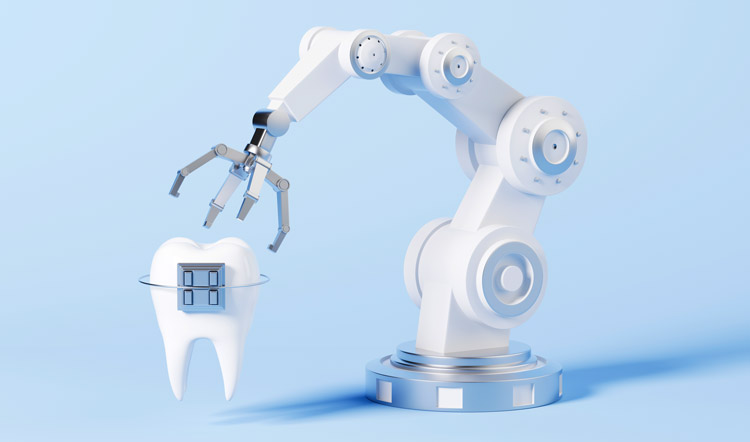
(The above image is for illustrative purposes only)