By Dr. I. Manimozhi
For decades, medicine has operated on an uncomfortable truth: we often treat the average patient, not the actual individual sitting in the clinic. But a massive seismic shift is underway. By merging generative artificial intelligence with quantum-powered computing, we are finally stepping into an era of truly individualized care. This isn’t a subtle iteration or a minor tech upgrade; it is a complete restructuring of modern healthcare.
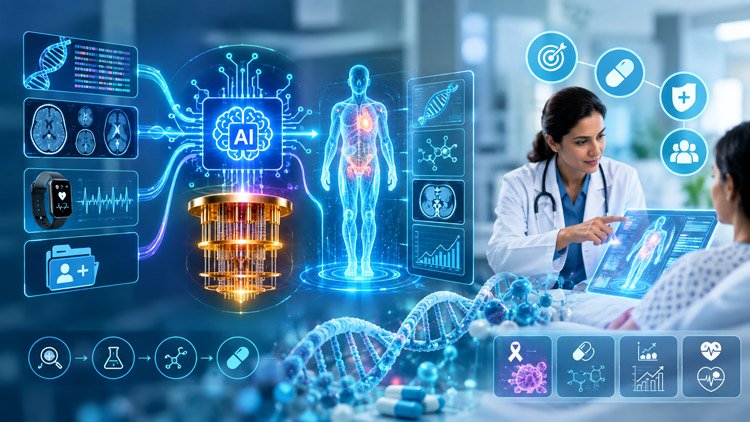
The immediate superpower of this architecture is its ability to smash data silos. Historically, a patient’s health story has been completely fragmented across disconnected networks -trapped inside electronic medical records, massive genomic datasets, diagnostic imaging repositories, and continuous feeds from consumer wearable devices. When intelligent software synthesizes these disparate information streams all at once, it unmasks deeply hidden patterns. This grants clinicians the foresight to catch diseases early, map out hyper-personalized risk metrics, and pick the exact clinical therapies that a patient’s body will actually respond to.
However, traditional binary computing hits a hard ceiling when faced with these massive, multidimensional data layers. That is where quantum computing changes the game. Quantum platforms process variables in ways classical machines simply cannot, making short work of high-dimensional, hyper-complex optimization equations. This brute, sophisticated processing power is turning into an absolute necessity for molecular modeling and streamlining the volatile process of drug discovery.
This combined force doesn’t just shave years off clinical research timelines; it drives down astronomical development costs and equips doctors with sharper, real-time tools for clinical decisions. Furthermore, using AI to engineer high-fidelity synthetic data solves a long-standing crisis in medical research – it allows us to bypass data scarcity and strict patient privacy roadblocks without degrading the reliability of our clinical systems.
But we cannot afford to blind ourselves to the friction points of this technological leap. If we are deploying these models into high-stakes clinical scenarios where lives hang in the balance, they cannot operate as unexplainable “black boxes”. Physicians must have absolute transparency to understand exactly how an AI arrived at a specific conclusion. Beyond explainability, we must actively resolve deep-seated ethical concerns surrounding automation, protect patient data with ironclad security, and find ways to scale up highly sensitive, volatile quantum hardware. Quantum-enhanced GenAI leverages advanced machine learning models and quantum algorithms to analyze vast and complex biomedical datasets, including genomic sequences, proteomic profiles, medical imaging, electronic health records, and real-time physiological data. By uncovering hidden patterns and intricate molecular interactions that are difficult for classical systems to detect, these technologies enable highly precise disease prediction, diagnosis, and treatment planning.
Take cancer care, for instance. Quantum-enhanced GenAI can dig into a patient’s genetic makeup, spot the specific mutations driving their disease, and point doctors toward therapies more likely to work for that person. In drug discovery, the same approach lets researchers model how molecules behave down at the atomic level, which can shave significant time and money off the development process. It’s also useful for building treatment plans that aren’t fixed in stone – the system keeps adjusting its recommendations as it sees how a patient actually responds.
There’s a preventive side to this too. Because the technology can pick up on disease risk before any symptoms show up, doctors get a chance to step in early rather than treat problems after the fact. Taken together, these tools could make clinical decisions faster, bring care within reach for more people, and give physicians a stronger hand in offering treatment that’s grounded in evidence and built around the patient in front of them.

Dr. I. Manimozhi is Professor & HOD, Department of Computer Science & Engineering, East Point College of Engineering and Technology, Bengaluru