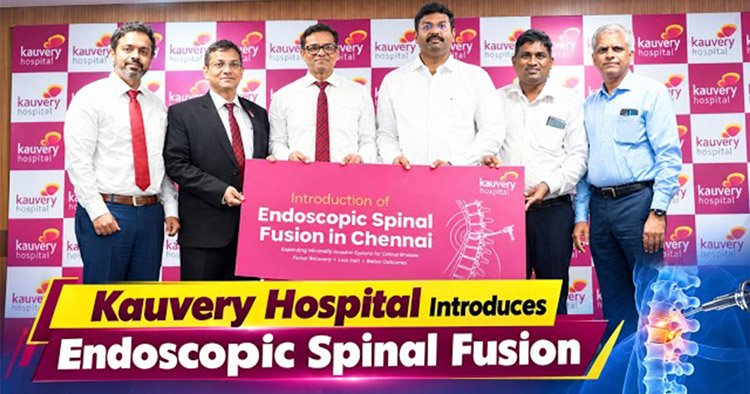
Kauvery Hospital, Alwarpet, has introduced endoscopic fusion surgery, offering a minimally invasive option for selected patients with lower-back spinal problems.
The technique uses an incision of about 8 mm. A working channel and high-definition camera allow surgeons to access the spine while limiting damage to surrounding muscles, bones and ligaments.
During the procedure, doctors can relieve nerve pressure, prepare the disc space and insert an interbody implant along with fixation.
The approach may be considered for patients with conditions such as degenerative lumbar disease, spinal stenosis, disc disorders, low-grade spinal instability and ongoing nerve-root compression. It can also be used in some revision spine procedures and may benefit selected elderly patients who could face higher risks from major open fusion surgery.
Compared with conventional open surgery and standard minimally invasive techniques, endoscopic fusion is designed to reduce tissue trauma, blood loss and postoperative pain. It may also support faster mobilisation and shorter hospital stays.
“Endoscopic procedures are also used for disc herniation and nerve compression,” said Dr. Keerthivasan P, senior consultant spine and orthopaedic surgeon at Kauvery Hospital Alwarpet, Chennai. “In certain cases, they may help avoid the need for extensive fusion by preserving the spine’s natural stability.”
However, the procedure is not appropriate for every patient. According to Dr. Keerthivasan, high-grade spinal slips, certain complex deformities and conditions requiring extensive reconstruction may still need conventional surgery.
The introduction of endoscopic fusion adds another minimally invasive option for spine care in Chennai, particularly for carefully selected patients who may benefit from less extensive surgical intervention. (Photo credit: youtube/View7media)