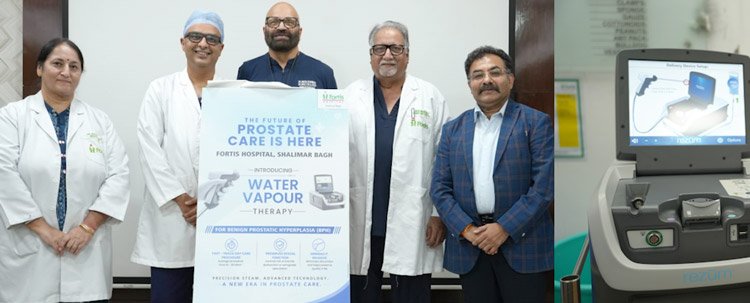
Fortis Hospital, Shalimar Bagh, has introduced Rezūm Water Vapor Therapy for men suffering from urinary problems linked to benign prostatic hyperplasia (BPH), or an enlarged prostate. The hospital says it is the first multi-speciality hospital in Delhi NCR to offer this minimally invasive treatment.
BPH is a non-cancerous condition in which the prostate enlarges with age and can affect normal urine flow. In India, studies suggest that BPH-related symptoms affect about 25% of men aged 40-49, around 37% of those aged 50-60 and more than half of men above 60.
Steam-based treatment for enlarged prostate
Rezūm therapy uses controlled water vapour to treat excess prostate tissue. The targeted tissue gradually shrinks, helping reduce blockage and improve urinary symptoms.
The procedure is minimally invasive and can generally be performed as a day-care treatment without general anaesthesia. This can allow patients to recover faster and return to their regular activities sooner.
For suitable patients, the therapy may provide another option apart from conventional surgery or prolonged medication. Fortis said five-year clinical data showed lasting improvement in symptoms, with 4.4% of patients requiring further surgery. The treatment is also linked with a lower risk of sexual dysfunction compared with some traditional surgical procedures.
Dr. Anurag Puri, Additional Director – Urology, Fortis Hospital, Shalimar Bagh, said the treatment could help patients who are reluctant to undergo conventional surgery because of concerns about hospitalisation, bleeding and sexual function.
“Rezūm Water Vapor Therapy is a game-changer as it uses natural steam to treat targeted tissue in minutes, requires minimal anaesthesia, and preserves sexual function,” he said.
Naveen Sharma, Vice President & Facility Director, Fortis Hospital, Shalimar Bagh, said the launch is part of the hospital’s efforts to adopt patient-focused technology and expand minimally invasive treatment options.
Expanding treatment choices for BPH
The introduction of Rezūm therapy could give men across Delhi and North India another option for managing urinary symptoms caused by an enlarged prostate. However, the suitability of the procedure depends on individual clinical assessment and evaluation by a specialist.
Overall, the new treatment adds to the growing range of minimally invasive approaches available for BPH, potentially helping eligible patients manage symptoms with a shorter and less invasive treatment pathway.
(Photo courtesy: fortishealthcare.com)