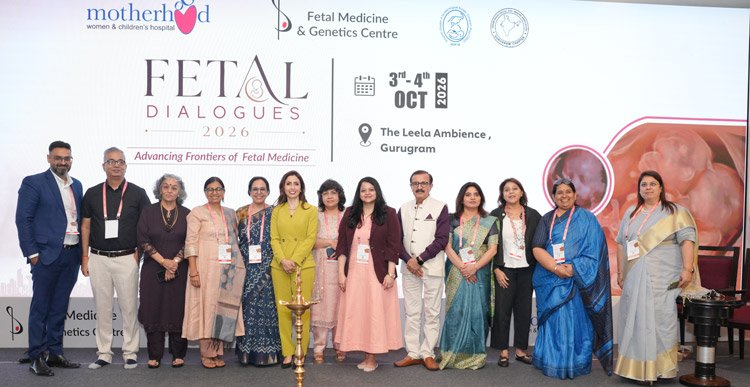
7 October 2026, Gurgaon: Motherhood Hospitals, in collaboration with Fetal Medicine & Genetics Centre, successfully hosted “Fetal Dialogues 2026” on October 3–4 at The Leela Ambience, Gurugram, a groundbreaking conference aimed at enhancing skills among healthcare professionals dedicated to fetal care. This inaugural event saw an impressive assembly of eminent fetal medicine experts from across the nation, fostering an environment ripe for knowledge exchange and pioneering approaches to prenatal healthcare.
The inaugural medical conference brought together eminent faculty from across India, including Dr. Anita Kaul, Dr. Ratna Puri, Dr. Chanchal Singh, Dr. Siddhesh Pandey, Dr. Sandeep Yadav, Dr. Seema Thakur, Dr. Balu Vaidyanathan and Dr. Meenu Handa. The programme also featured Motherhood Hospitals specialists Dr. Preety Aggarwal, Dr. Shweta Wazir and Dr. Sanjay Wazir alongside UK-based Professor Asma Khalil, Dr. Shreyasi Sharma, Organizing Secretary. Their participation brought together expertise in fetal medicine, genetics, pregnancy care and on improving outcomes for unborn babies.
According to the World Health Organization, an estimated 2.4 lakh newborns worldwide die within the first 28 days of life each year due to congenital disorder conditions that develop before birth, including certain heart defects and genetic conditions. These figures underline the importance of pregnancy assessments, specialist counselling and coordinated care. While prenatal tests cannot identify every condition, they can help detect certain concerns and guide further investigation, treatment planning and support for families.
Dr. Shreyasi Sharma, Organizing Secretary, Fetal Dialogues 2026, said, “Fetal Dialogues upholds the true spirit of dialogue, where clinical wisdom is gathered, tested, challenged and passed on. We are having these dialogues for the unborn who are not yet able to speak for themselves. The two-day programme was centered on twin and multiple pregnancies, babies growing more slowly than expected, detailed examination of the developing brain and heart and advances in genetics. Various workshops, demonstrations and unique case discussions explored how doctors can pick up abnormalities early and make informed decisions throughout pregnancy, thereby giving every unborn a fighting chance at life
Dr. Preety Aggarwal, Medical Director, Obstetrics and Gynecology, Motherhood Hospitals, Gurgaon, said, “The event reinforced that good pregnancy care begins with understanding both the mother’s health and the baby’s development. Advances in ultrasound and genetic assessment can help us recognize concerns earlier, but their value depends on careful interpretation and clear counselling. As obstetricians, we must connect these findings with the mother’s medical history and individual needs. The conference encouraged us to review clinical decisions, exchange experiences and strengthen collaboration with fetal medicine and newborn specialists. For families, this means clearer guidance, timely referrals and a coordinated care plan that supports informed decisions throughout pregnancy, delivery and the period after birth.”
Dr. Shweta Wazir, Senior Consultant, Obstetrician and Gynecologist, Motherhood Hospitals, Gurgaon, said, “One of the most valuable lessons from Fetal Dialogues 2026 was the importance of looking beyond a single scan result. When a baby appears small, or a twin pregnancy becomes complicated, we need to assess growth patterns, blood flow, and the mother’s condition together. Practical workshops and case discussions helped doctors examine these situations and refine their approach to monitoring and delivery planning. Equally important is explaining uncertainty to parents without creating unnecessary fear. Applying evidence thoughtfully, arranging appropriate follow-up and involving specialists when needed can help us provide care that responds to the specific needs of each individual pregnancy.
Dr. Sanjay Wazir, Medical Director (NCR)- Neonatology, Motherhood Hospitals, Gurgaon, said, “Care for a vulnerable newborn should begin before birth whenever concerns are identified during pregnancy. The event highlighted how communication between obstetricians, fetal medicine specialists and neonatologists can help teams prepare for premature babies, babies with growth concerns and those with suspected developmental conditions. Prenatal information helps us plan the delivery setting, equipment and specialist support that may be required. It also allows families to understand possible challenges and the care their baby might need. The conference strengthened our focus on coordinated planning, timely communication and continuity of care, linking assessments during pregnancy with appropriate support immediately after delivery.”
Fetal Dialogues 2026 concluded with an emphasis on turning medical advances into practical care for mothers and babies. Through expert-led workshops, case discussions and shared clinical experiences, the conference encouraged doctors to strengthen assessment skills, recognize concerns earlier and work closely across specialties. The focus extended beyond identifying risks to helping families understand findings and planning appropriate care before and after birth. The inaugural edition laid the foundation for continued learning and collaboration, with the aim of making prenatal care more informed, coordinated, and responsive to the needs of each pregnancy.