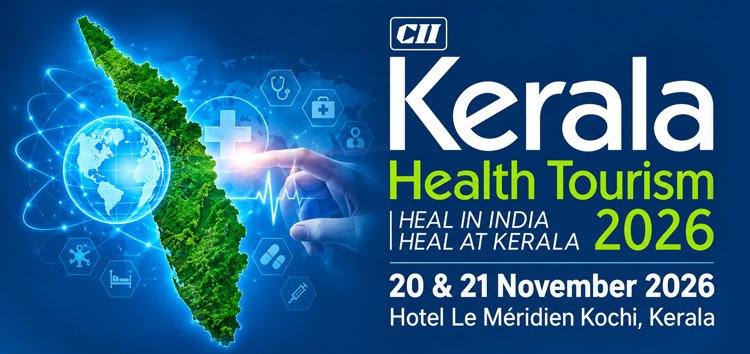
Keralam could require another 10,000 hospital beds to meet growing healthcare needs, presenting a significant opportunity for investment in the state’s medical infrastructure and healthcare tourism sector. Industry experts highlighted this potential at the CII Global Ayurveda Summit and Expo & Kerala Health Tourism 2026, emphasising the need to strengthen healthcare capacity and expand international patient services.
The growing demand for medical services, particularly in the post-pandemic period, has created an opportunity for Keralam to strengthen its position as a healthcare destination while attracting a larger share of international medical travellers.
Inaugurating the summit, Additional Chief Secretary A.P.M. Mohammed Hanish stressed the importance of combining technological advancements with traditional healthcare practices, particularly Ayurveda. He noted that the sector was becoming increasingly dependent on technology and skilled human resources, making qualified practitioners and scientifically validated treatments essential.
Joseph M. Kallivayalil, Chairman of the CII Kerala State Council, observed that the state had considerable untapped potential to attract more international patients travelling to India for medical treatment.
Highlighting the priorities for the Ayurveda industry, Saji Kumar, Co-chairman of the CII National Ayush Committee, identified five key areas: evidence-based trust, alignment with international standards, accessible and affordable treatment through insurance, global acceptance and organisational excellence.
Professor Rabinarayan Acharya, Director General of the Central Council for Research in Ayurvedic Sciences, underlined the importance of research and scientific validation in strengthening Ayurveda’s credibility. He also called for greater efforts to address misinformation about Ayurveda circulating on social media.
Providing a broader perspective on India’s healthcare infrastructure, Giridhar J. Gyani, Director General of the Association of Healthcare Providers India (AHPI), said Keralam had achieved the World Health Organization’s benchmark of three hospital beds per 1,000 people. In comparison, Bihar had just 0.3 beds per 1,000 population. At the national level, India has approximately 2.1 million hospital beds, a number that would need to double to meet WHO requirements.
Gyani also highlighted India’s growing medical tourism market, which generated an estimated $8.5 billion in 2025, with considerable scope for further expansion. He identified international air connectivity as an important factor in strengthening the country’s appeal among overseas patients.
He further pointed out that healthcare demand across India continued to exceed available capacity, affecting the overall quality of medical services. Citing Thailand as an example, he emphasised the importance of balancing clinical excellence with quality patient services.
P.V. Louis, Chairman of CII Health Tourism 2026, said Keralam’s healthcare professionals enjoyed international recognition. He stressed that the state should promote this strength more actively and position its medical expertise alongside its established tourism offerings.
With growing healthcare demand, recognised medical expertise and a strong foundation in traditional medicine, Keralam has significant opportunities to expand its healthcare infrastructure and medical tourism industry. Strategic investments in hospital capacity, research, technology, international connectivity and patient services could further strengthen its position as a preferred global healthcare destination.