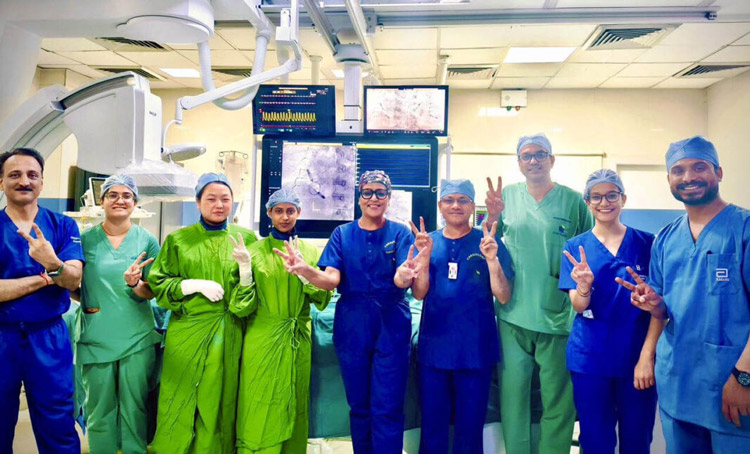
Doctors at Indraprastha Apollo Hospitals have carried out what is being described as India’s first implantation of a leadless pacemaker through a metallic prosthetic tricuspid valve, marking a major breakthrough in advanced cardiac care.
The complex procedure was performed on a 65-year-old patient under the leadership of Dr Vanita Arora, Clinical Lead – Cardiac Electrophysiology. The achievement offers a less invasive treatment pathway for high-risk heart patients who previously had limited pacing options.
The patient had a long medical history dating back to 1998, when he underwent pancreaticojejunostomy surgery. Following the procedure, he developed fungal infective endocarditis involving the tricuspid valve. In 2000, he required surgery to remove infected tissue from the valve. Years later, worsening tricuspid valve leakage caused right-sided heart failure symptoms, eventually leading to replacement of the valve in 2018 with a 31 mm metallic bileaflet mechanical prosthesis.
More recently, the patient began experiencing dizziness and near-fainting episodes. Detailed evaluation confirmed symptomatic sinus node dysfunction along with atrioventricular conduction disease, making permanent cardiac pacing necessary.
Conventional pacemaker implantation, however, was ruled out because standard pacing leads cannot safely cross a mechanical tricuspid valve. Doing so may damage the prosthetic valve and increase the risk of thrombosis, valve malfunction and lead-related complications. Another open-heart surgery for epicardial lead placement was also considered highly risky due to the patient’s history of multiple cardiac operations.
To overcome these challenges, the electrophysiology team selected a leadless pacemaker system. Unlike traditional pacemakers, the device does not require wires inside the heart. Instead, the compact unit is delivered directly into the heart through a catheter inserted via a vein in the leg.
In this case, doctors implanted a dual-chamber Aveir leadless pacemaker designed to maintain atrioventricular synchrony. The procedure involved detailed cardiac mapping, careful navigation through the mechanical valve and accurate positioning of the device inside the right ventricle. The implantation was completed successfully while preserving the function of the artificial valve.
Dr Vanita Arora said, “Patients with mechanical tricuspid valves who require pacing present a unique challenge because conventional pacemaker leads cannot be passed across the valve. Leadless pacing technology allowed us to safely restore heart rhythm without repeat open-heart surgery, offering an important option for patients with complex surgical histories.”
The patient recovered well after the intervention and was discharged in stable condition.
The successful procedure represents a major advancement in cardiac electrophysiology in India and showcases how innovative leadless pacing technologies are transforming treatment for complex heart patients. Experts believe such minimally invasive interventions could improve safety, reduce surgical risks and expand treatment possibilities for patients with prosthetic heart valves and complicated cardiac histories.
(Photo courtesy: apollohospitals.com)