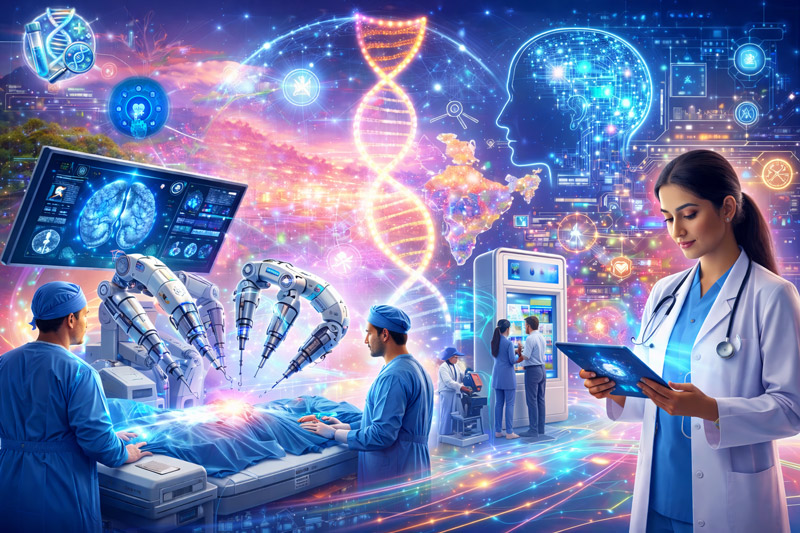
India’s healthcare story is entering a bold new chapter. By 2026, the country is no longer defined solely by affordable treatment—it is emerging as a global epicenter of medical technology, precision care, and innovation-driven healing. From AI-powered diagnostics and robotic surgeries to genomics, digital health platforms, and intelligent population health systems, India is blending advanced science with compassionate care at an unprecedented scale.
This feature explores the technologies reshaping India’s healthcare ecosystem and redefining medical tourism for the world. What follows is a journey through cutting-edge innovations that are making faster diagnoses possible, surgeries safer, care more personalized, and healing more accessible—positioning India as a destination where the future of medicine is already unfolding.
Here’s a snapshot of the most transformational medical technologies emerging from India today.
By MTT Research Desk
AI-Powered Diagnostics and Imaging Technologies
One of India’s foremost breakthroughs in recent years has been the adoption of artificial intelligence across diagnostics. Indian hospitals and research labs are deploying AI systems that can interpret medical images — including X-rays, CT scans, and MRIs — with astonishing accuracy and speed, often detecting earlier signs of disease than conventional methods. These platforms help healthcare providers identify complex pathologies, reduce diagnostic delays, and streamline patient management, especially in remote or underserved areas.
Beyond radiology, machine learning tools are also being used to read pathology results and classify disease severity automatically, making specialized interpretation more scalable and widely available.
Robotic Surgery & Tele-Operated Systems
India’s medical robotics sector has evolved from being purely imported technology to one with indigenously developed systems that support minimally invasive procedures across multiple specialties. Native robotic platforms are now in use for general surgery, urology, gynecology, and oncology, providing microscopic precision, reducing patient trauma, and enabling faster recovery times.
In parallel, remote robotic surgery technologies allow expert surgeons to operate across distances — linking specialists with patients in cities or countries where high-end expertise was previously inaccessible. This leap is particularly important for medical tourism, where patients might receive expert surgical care with fewer travel constraints, coupled with local postoperative support when they return home.
Biotech & Genetic Testing
India’s biotech revolution is powering rapid diagnostics and personalized medicine through next-generation DNA sequencing, biomarker screening, and molecular assays. These advancements allow earlier detection of infections, better assessment of genetic disorders, and more precise cancer profiling — all critical factors in treatment planning for international patients seeking tailored care pathways.
Hospitals and labs across metro cities now offer molecular diagnostics that once required overseas referral, making India a destination for advanced genetic evaluation and targeted therapies.
Digital Health & Telemedicine Platforms
Telemedicine in India has moved well beyond video consultations. Modern platforms now integrate with national health infrastructure, electronic medical records, and remote monitoring devices. Patients can connect with specialists for pre-travel assessment, receive treatment plans digitally, and continue postoperative care virtually, reducing the need for repeated travel.
These platforms also feature multilingual AI health assistants capable of voice interaction, symptom triage, and teleconsultation support — an essential feature for international patients and users with limited digital literacy.

Health Kiosks and Automated Screening Units
Automated health stations — sometimes called “health ATMs” — are being rolled out in tier-2 and tier-3 cities. These units allow users to self-measure essential health indicators such as blood pressure, ECG, oxygen saturation, blood glucose, and body mass index without scheduling a clinic visit. Coupled with telehealth connections, these kiosks extend basic diagnostic services to remote regions while funneling data into specialist evaluation pipelines.
AI-Integrated Vaccination & Population Health Systems
Innovative systems using AI to monitor vaccination patterns, identify coverage gaps, and send personalized reminders are emerging at the district level. By greatly improving routine immunization rates, these tools strengthen preventive care infrastructure and reduce disease burdens — an indirect but powerful advantage for long-term public health, particularly for elderly or international patients seeking preventive care packages.
Expansion of Medical Startups and MedTech Innovation
India’s startup ecosystem is fertile ground for medical technology. From companies creating robotic consoles for remote sensing and surgical assistance to firms developing advanced navigation systems that enhance operating room precision, these innovations are not only bolstering domestic healthcare capacity but preparing Indian solutions for global markets.
India has also streamlined processes for licensing publicly funded innovations to industry, encouraging wider adoption of breakthrough products like advanced ELISA kits, next-generation vaccines, and point-of-care diagnostics.
Quantum Computing for Healthcare Research
While still in emerging stages, India’s progress in quantum computing — including the launch of indigenous quantum systems — promises to accelerate computational biology, drug discovery simulations, and large-scale health data analytics. Though not yet pervasive in clinical settings, these capabilities could redefine future precision medicine research and pharmacology.
Integrated Health Data Networks
Unified health data initiatives now link patient records, diagnostics, and real-time health indicators through secure systems that provide clinicians with holistic insights into each case. By leveraging national digital health frameworks, care teams can deliver more informed and coordinated treatments — a major plus for patients with complex, multi-stage care plans or international follow-ups.
Why These Innovations Matter for Medical Tourism in India
For international patients, India’s cutting-edge medical technologies translate into:
- World-class care at competitive costs
- Reduced travel burden through pre- and post-treatment telecare
- Faster diagnostics enabling earlier intervention
- Tailored treatment plans built on genetic and AI-driven insights
- Expanded access to specialists via robotic and remote systems
- Enhanced preventive care and wellness options
India is no longer a destination of affordability alone — it’s a destination of innovation-led, patient-centric healthcare.
As India moves confidently into 2026, its healthcare evolution reflects more than technological progress—it signals a shift in how care is imagined, delivered, and experienced. By combining advanced medical technologies with clinical expertise, digital connectivity, and a deeply patient-centric approach, India is redefining its position on the global healthcare map. For international patients, the country now represents a destination where innovation meets trust, precision meets affordability, and healing is supported by both science and compassion. The future of healthcare is unfolding here, and India stands ready to lead it.