By Dr. MDS Sasidharan
——————————-
Every morning, there is a familiar checklist in homes with school-going children.
“Books packed?”
“Yes, Amma.”
“Lunch box?”
“Yes.”
“Water bottle?”
“Yes.”
“Homework?”
“Yes!”
Then comes the final step. The child puts on the school bag, bends slightly forward under its weight and walks out of the house. And most of us simply watch them go.
But there is one simple question every parent should ask: Have you ever weighed your child’s school bag?
Most parents know their child’s weight, height, shoe size and uniform size. But how many of us know how much weight our child carries on their back every school day?
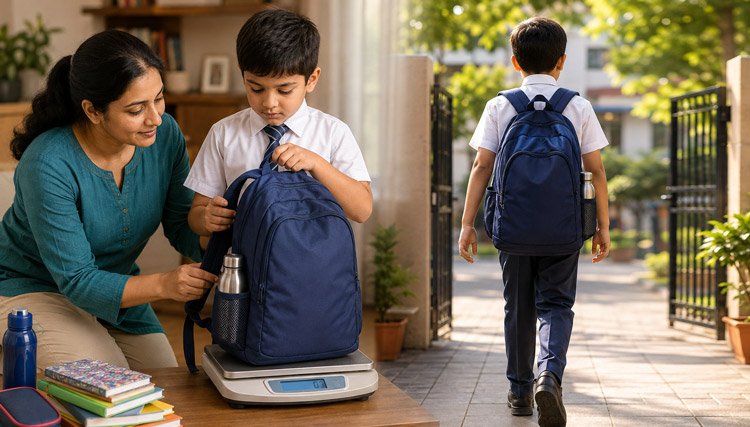
With schoolbag weight becoming an increasing concern, a simple check at home can make parents more aware. Weigh your child and then weigh the fully packed school bag. The result may be surprising.
The 10% Test
The Government of India’s School Bag Policy 2020 recommends that a school bag should be around 10% of a child’s body weight for Classes I to X and recommends no school bag for pre-primary children.
For example, if a child weighs 25 kg, 10% would be 2.5 kg.
Now place the fully packed school bag on a weighing scale.
Textbooks, notebooks, lunch box, water bottle, pencil box, art material, sports clothes and worksheets can quickly add up. Sometimes, a bag that looks relatively small can weigh 4 kg or more.
Imagine an adult weighing 70 kg carrying 14 kg on their back every day. Would we consider that comfortable?
Probably not.
So why should we expect a growing child to simply “get used to it”?
At the same time, as a spine surgeon, I would like to make one thing clear: a school bag is not automatically going to damage a child’s spine. Parents should not be unnecessarily frightened.
The concern is much broader. It is about the overall physical routine of today’s child.
The School Day Has Changed
Think about a typical child’s day.
They wake up and get into a car or school van. They sit during the journey, sit in class, sit while studying, return home and sit again for homework or tuition. Then they may spend additional time sitting in front of a screen.
The important question is: How much time did they actually spend moving?
Where is the running? The cycling? The climbing? The outdoor game? The simple, unstructured play that children once did naturally?
The World Health Organization recommends that children and adolescents between 5 and 17 years should get an average of at least 60 minutes of moderate-to-vigorous physical activity every day, including activities that strengthen muscles and bones at least three times a week.
Therefore, when we talk about a child’s spine, we should not look only at the weight of the school bag. We should also ask:
Is the child physically strong enough to carry it?
A child who runs, plays, climbs and develops good muscle strength has a very different physical routine from a child who spends most of the day sitting.
Perhaps the bigger question is not only, “Is my child’s school bag too heavy?” but also, “Is my child’s entire day too sedentary?”
A Heavy Bag Doesn’t Always Look Heavy
Tomorrow morning don’t just look at the bag. Look at your child.
Ask your child to put the bag on and walk normally. Observe them from the side.
Are they leaning forward? Are the shoulder straps slipping? Are both straps being used? Are the shoulders being pulled down? Does the child struggle while putting the bag on? Do they complain that the bag hurts? Do they habitually carry it over one shoulder?
These simple observations can tell us much more than simply looking at a bag and deciding that “it isn’t that big.”
A good school bag should be lightweight, have two padded and adjustable straps, and allow the load to be distributed comfortably over both shoulders.
But there is another simple principle I tell parents:
The best school bag is not necessarily the most expensive one. It is the one carrying only what the child actually needs.
Try the Sunday School-Bag Test
One simple habit can make a difference.
Once a week, empty the entire school bag.
Everything.
You may find three old notebooks, yesterday’s worksheets, an extra water bottle, a forgotten lunch box, books that are no longer required and a pencil box large enough to supply an entire classroom.
Then ask your child:
“Do you really need to carry this tomorrow?”
Make it a five-minute Sunday routine. It can reduce the weight of the school bag without spending a single rupee.
More importantly, make the child responsible for it. Learning to organise what they carry is a useful life skill too.
Are Trolley Bags Really the Answer?
Parents often ask, “If the bag is heavy, why not buy a trolley bag?”
It sounds logical. But wheels do not automatically make a school bag better.
A trolley bag may be easy to pull on a flat surface, but what happens when the child reaches a staircase? What happens on uneven ground, in a crowded corridor or when the child has to lift the bag?
The Government of India’s School Bag Policy also discusses concerns associated with wheeled carriers in school environments.
So before buying another bag, I would ask a more basic question:
Why does the child need to carry so much in the first place?
Sometimes the simplest solution is not a better bag.
It is a lighter bag.
“Doctor, My Child Has Back Pain”
This is where parents should neither panic nor dismiss the complaint.
Children can experience fatigue after a long school day. An occasional complaint of tired shoulders does not automatically mean there is a spinal problem.
However, persistent or recurrent pain should not simply be dismissed as “growing pains.”
If a child repeatedly complains of back or neck pain, particularly if it interferes with school, sports or sleep, it deserves medical attention.
Pain associated with weakness, numbness, difficulty walking, fever, unexplained weight loss or other unusual symptoms should also be medically assessed.
The important message for parents is simple:
Do not diagnose the child yourself, but do not ignore a repeated complaint either.
The Real School-Bag Test
So, parents, here is a simple challenge.
Tomorrow morning, before your child leaves for school, weigh the child and weigh the fully packed school bag. Check whether the bag is around 10% of the child’s body weight. Check both shoulder straps and make sure the bag sits comfortably.
Remove items that are not required that day.
Watch your child’s posture while walking with the bag.
And then ask one more question:
“How much did you play yesterday?”
That question may be as important as the weighing scale.
Protecting children’s spines is not simply about reducing the weight they carry. It is also about making sure they move enough.
A child should not spend the entire day carrying a bag, sitting in a classroom, sitting in a vehicle, sitting for homework and then sitting in front of a screen.
Children need to run. They need to jump. They need to climb. They need to play. They need to develop strong muscles and healthy bones.
They need movement.
Perhaps we have become so focused on making our children academically strong that we sometimes forget to make them physically resilient.
So tonight, don’t ask only:
“Did you finish your homework?”
Pl ask, “What’s inside your school bag?”
And then ask something even more important:
“How much did you move today?”
Because sometimes, protecting a child’s spine does not begin in a hospital or with a scan.
It begins at home—with a weighing scale, a lighter school bag and an hour of active play every day.

Dr. MDS Sasidharan is a Senior Consultant, Department of Spine & Scoliosis Surgery, Iswarya Hospital, Chennai