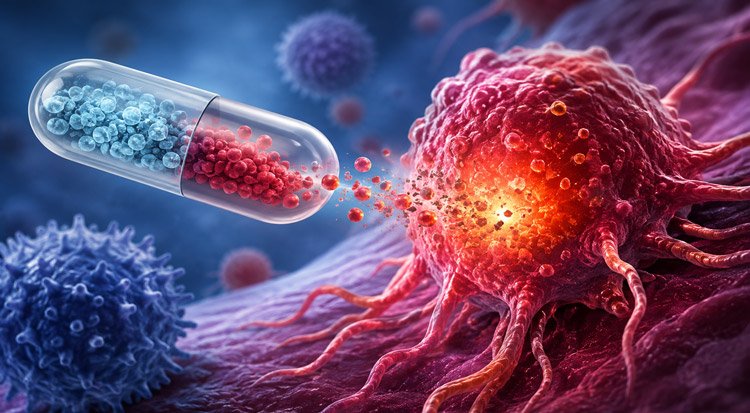
Indian scientists are developing a new experimental cancer drug that is designed to become active mainly inside tumour cells. Called RK-251, the candidate uses high levels of reactive oxygen species (ROS) found in many cancer cells as a trigger for releasing its cancer-fighting compound.
The approach could eventually help make cancer treatment more selective and limit damage to healthy tissues. However, RK-251 is still at the preclinical research stage and cannot currently be described as a replacement for chemotherapy.
The research was led by Dr Asis Bala of the Institute of Advanced Study in Science and Technology (IASST), an autonomous institute under India’s Department of Science and Technology, in collaboration with Dr K.P. Bhabak of the Indian Institute of Technology-Guwahati. The findings were published in the ACS Journal of Medicinal Chemistry.
Chemotherapy is designed to attack cells that divide rapidly, a feature common in many cancers. The problem is that some healthy cells also reproduce quickly.
Cells in the hair follicles, digestive system and bone marrow can therefore be affected by chemotherapy. Depending on the drug and treatment plan, patients may experience hair loss, nausea, mouth sores, tiredness and a drop in blood-cell counts.
This long-standing challenge has driven research into treatments that can better distinguish cancer cells from normal cells.
The researchers behind RK-251 are taking a different approach by using a biological feature often associated with cancer: elevated oxidative stress.
Reactive oxygen species, or ROS, are naturally produced during normal cellular activity. Healthy cells generally keep them under control. Cancer cells, however, can have altered metabolism and higher oxidative stress, leading to increased ROS levels.
When the molecule encounters high ROS levels, it undergoes a chemical change that releases NBDHEX, the active anticancer compound. In effect, RK-251 is intended to function like a molecular switch that is activated by conditions inside cancer cells.
NBDHEX acts on proteins and biological pathways linked to cancer-cell survival and resistance to treatment.
By disrupting these processes, the compound may make it harder for cancer cells to survive. The researchers hope that RK-251 can therefore deliver NBDHEX more selectively to tumour cells while limiting its impact on healthy tissue.
Still, promising activity in laboratory experiments does not necessarily mean that the same results will occur in human patients.
Initial preclinical experiments showed encouraging results against triple-negative breast cancer cells, an aggressive type of breast cancer that can be difficult to treat.
According to the researchers, RK-251 produced stronger effects on cancer cells than on healthy cells in the experimental models used.
The candidate was also evaluated using zebrafish embryos (Danio rerio). Under the conditions tested, researchers did not observe obvious signs of toxicity during behavioural and toxicity assessments.
Another finding supported the drug’s proposed mechanism: RK-251 produced the expected fluorescence response when exposed to reactive oxygen species, indicating that the ROS-triggered activation process was taking place.
These results are useful for further research, but they remain early-stage findings.
Can RK-251 Replace Chemotherapy?
Not at this stage.
RK-251 has not yet gone through human clinical trials. Its safety, effectiveness, appropriate dosage and behaviour inside the human body still need to be established.
Before an experimental drug can become an approved cancer treatment, researchers must determine how the body absorbs and processes it, what dose can be safely given, whether it can control or shrink tumours in patients and whether its benefits outweigh potential risks.
Clinical development normally begins with early trials focused largely on safety and dosing, followed by larger studies designed to assess effectiveness and compare the treatment with existing options.
For this reason, calling RK-251 a replacement for chemotherapy would be premature.
Cancer includes many different diseases, each with its own biology. Even patients with the same cancer type can respond differently to the same treatment.
One major goal of modern cancer research is therefore to develop therapies that target specific features of tumour cells while sparing healthy tissue as much as possible.
RK-251’s ROS-sensitive design is interesting because it attempts to exploit a difference between cancer cells and normal cells. If future studies confirm that the drug can consistently activate in tumours without causing unacceptable toxicity, the approach could contribute to the development of more targeted cancer medicines.
Further preclinical testing will be needed before RK-251 can be considered for human trials.
Researchers will need to examine how reliably the drug is activated inside tumours, whether its selectivity holds up in more complex biological systems, what toxic effects may appear and whether it can deliver meaningful tumour control in animal studies.
Only after sufficient evidence is generated could the candidate potentially advance to clinical trials and regulatory assessment.
Even if RK-251 eventually reaches patients, it may not necessarily replace chemotherapy. Depending on the cancer and individual response, a targeted drug could instead be used alongside treatments such as chemotherapy, immunotherapy or surgery.
RK-251 represents an interesting attempt to make cancer treatment more selective by using the high ROS environment found in many tumour cells as an activation trigger. Early laboratory and zebrafish studies are encouraging, but the drug remains experimental. Its ability to become a genuine cancer treatment—and whether it could ever reduce the need for chemotherapy—will depend on the results of further preclinical research and carefully conducted human clinical trials.