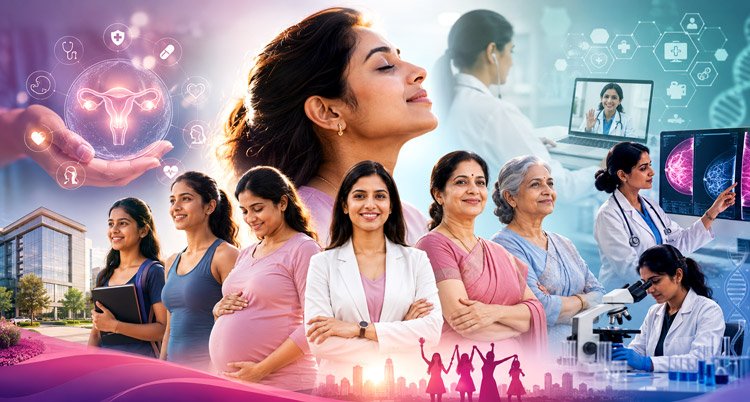
India’s women’s healthcare sector is entering a transformative new era. What was once centred largely on fertility, pregnancy and reproductive care is evolving into a lifelong healthcare ecosystem spanning prevention, diagnostics, chronic disease, cancer, menopause, digital health and healthy ageing. Driven by rising awareness, changing lifestyles, increasing healthcare spending and rapid technology adoption, women’s health is emerging not only as a critical public-health priority but also as one of India’s most promising healthcare growth opportunities.
By MTT Research Desk
India’s women’s healthcare landscape is undergoing a significant transformation. For decades, women’s health was largely viewed through the lens of pregnancy, childbirth, contraception and fertility. Today, that definition is expanding rapidly to include preventive healthcare, chronic diseases, cancer, metabolic disorders, mental health, menopause, healthy ageing, diagnostics and technology-enabled care.
The shift is supported by changing demographics, greater health awareness, rising healthcare expenditure, expanding private healthcare infrastructure and the rapid adoption of digital health services.
A 2026 report by the Observer Research Foundation (ORF) argues that India needs to move from a predominantly reproductive-health model towards a life-course approach to women’s health, covering chronic disease, mental health, ageing, technology, healthcare financing and access to care.
At the commercial level, market-research firms provide different estimates because they use different definitions of the women’s health market. Precedence Research estimates India’s women’s health market at approximately US$2.43 billion in 2025, with the market projected to reach about US$4.83 billion by 2035, representing a CAGR of roughly 7.1%. Other research firms produce lower or higher estimates depending on whether their calculations include therapeutics, wellness, diagnostics, reproductive health or other categories.
These figures should therefore be viewed as market-specific estimates rather than a single official government valuation.
What is less disputed is the direction of travel: women’s healthcare is becoming a much larger and more diverse opportunity in India.
From Reproductive Healthcare to Whole-Life Healthcare
The biggest structural change is the expansion of the definition of women’s health.
A woman may encounter very different healthcare needs at different stages of life—from menstruation and anaemia during adolescence to contraception and fertility during reproductive years, pregnancy and postpartum care, and later cardiovascular disease, diabetes, osteoporosis, cancer and menopause-related conditions.
India’s latest National Family Health Survey provides evidence of both progress and emerging challenges.
NFHS-6, conducted during 2023–24, covered approximately 6.79 lakh households across 715 districts. The survey showed improvements in maternal healthcare, contraception and several other indicators. Institutional deliveries increased from 88.6% in NFHS-5 to 90.6% in NFHS-6, while antenatal-care coverage rose from 92.6% to 95.9%. The proportion of mothers receiving at least four antenatal visits increased from 58.5% to 65.2%.
At the same time, NFHS-6 highlights a growing burden of lifestyle-related health risks, reinforcing the need to look beyond maternal and reproductive healthcare.
Fertility and Contraception Remain Major Segments
Reproductive health remains one of the largest components of India’s women’s healthcare economy.
India’s total fertility rate has stabilised at 2.0, below the replacement level of 2.1. At the same time, contraceptive prevalence increased from 66.7% to 69.1% between NFHS-5 and NFHS-6, while unmet need for family planning declined from 9.4% to 8.5%.
The implications for healthcare providers are significant.
The market is increasingly shifting from simply improving access to contraception towards providing choice, counselling, fertility planning, infertility treatment and assisted reproductive services.
For many urban and middle-income families, delayed marriage, delayed parenthood and changing career priorities are also contributing to greater demand for fertility preservation, IVF and other reproductive technologies.
This creates opportunities for fertility centres, reproductive endocrinology services, diagnostics, pharmaceuticals and digital fertility platforms.
PCOS is Creating Demand for Long-Term Care
Polycystic ovary syndrome, or PCOS, has become an increasingly important women’s health issue in India.
Its significance extends well beyond fertility. Women with PCOS may require long-term management of menstrual irregularities, hormonal symptoms, metabolic risk, weight-related issues and reproductive challenges.
This is creating demand for a more integrated model of care involving gynaecologists, endocrinologists, nutrition specialists, diagnostics providers and digital health platforms.
The commercial opportunity is consequently shifting from one-time consultation to long-term disease management and monitoring.
Maternal Healthcare is Improving, But the Next Challenge is Quality and Continuity
India has made substantial progress in improving access to institutional maternity care.
NFHS-6 reported that 90.6% of births now take place in institutions, compared with 88.6% in NFHS-5. Skilled attendance at birth also improved from 89.4% to 91.3%.
These gains represent an important expansion of access. The next phase, however, will increasingly focus on the quality and continuity of maternal care, including high-risk pregnancy management, maternal nutrition, postpartum support, mental health and neonatal care.
For private hospitals and specialised healthcare networks, this creates opportunities to develop integrated maternity programmes rather than treating childbirth as an isolated episode of care.
Anaemia: A Critical Gap in Women’s Health
Anaemia remains one of India’s major women’s health challenges.
However, there is an important data-development issue in 2026. NFHS-6 did not publish its anaemia prevalence estimates in the fact sheets. The Ministry of Health and Family Welfare has stated that anaemia estimates will instead be based on an independent ICMR survey using a gold-standard intravenous method for haemoglobin testing.
Therefore, older NFHS-5 anaemia figures should not simply be presented as current NFHS-6 statistics.
The latest available NFHS-5 data had shown anaemia to be highly prevalent among women of reproductive age. This remains a significant public-health concern, particularly because anaemia affects maternal health, productivity, quality of life and child health.
India’s government programmes continue to address the issue through iron-folic acid supplementation, screening and nutrition interventions. The Ministry of Health’s 2025–26 annual report, for example, records large-scale adolescent iron-folic acid supplementation and menstrual-health interventions.
For the healthcare industry, this creates opportunities in diagnostics, nutrition, preventive screening and primary healthcare—not merely pharmaceutical treatment.
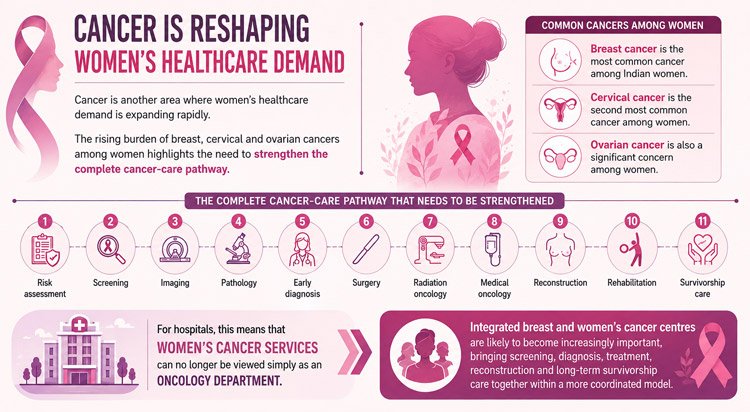
Cancer is Reshaping Women’s Healthcare Demand
Breast and Cervical Cancer Screening Offer a Major Opportunity
The scale of breast and cervical cancer in India also points towards a significant preventive-care opportunity.
Early detection can reduce the clinical and economic burden associated with late-stage disease. This creates opportunities for diagnostic centres, hospitals, mobile screening units and community healthcare programmes.
The challenge is particularly important outside major cities, where access to specialists and advanced diagnostics can be limited.
Technology can help bridge part of this gap through teleconsultation, digital referral systems, remote reporting and AI-assisted diagnostics—provided these tools are integrated into clinically supervised care pathways.
Menopause is Emerging as a New Healthcare Category
Menopause represents one of the most underdeveloped segments of women’s healthcare in India, but that is beginning to change.
Women are living longer, remaining economically active for longer periods and becoming more willing to seek professional help for symptoms affecting their quality of life.
Menopause care can encompass:
- Hormonal and symptom management
- Bone-health assessment
- Cardiovascular-risk assessment
- Diabetes and metabolic screening
- Mental wellbeing
- Sexual health
- Nutrition
- Exercise and lifestyle management
- Osteoporosis prevention
This creates an opportunity for specialised menopause clinics and multidisciplinary women’s health centres.
The broader life-course approach highlighted by ORF is particularly relevant here, as women’s healthcare needs do not end when reproductive years are over.
Women’s Health and Non-Communicable Diseases
One of the most important findings from NFHS-6 is the changing profile of women’s health risks.
Among women aged 15–49, 30.7% were reported as overweight or obese, compared with 27.3% of men. High or very high blood sugar, or use of medication to control blood sugar, increased among women aged over 15 from 13.5% to 17.8% between NFHS-5 and NFHS-6.
Hypertension among women aged over 15, meanwhile, declined from 21.3% to 19.4%.
These figures point to a growing need for women’s healthcare models that incorporate cardiovascular and metabolic health.
A modern women’s health centre may therefore increasingly include diabetes screening, blood-pressure monitoring, lipid assessment, nutrition counselling and lifestyle management alongside gynaecology.
Femtech is Moving Towards Clinical Integration
Technology is becoming an important component of India’s women’s health ecosystem.
The country’s femtech sector has attracted investment across fertility, menstrual health, pregnancy, mental health and digital healthcare. According to Tracxn data, Indian femtech startups raised more than US$286 million across 221 funding rounds between 2012 and 2025. Funding, however, has declined sharply from its earlier peak, signalling a more selective investment environment.
This funding shift may actually help mature the industry.
Investors are increasingly likely to favour businesses that can demonstrate clinical outcomes, recurring revenue and integration with healthcare delivery rather than consumer wellness alone.
The future of Indian femtech may therefore belong to hybrid models combining digital platforms with doctors, diagnostics, pharmacies, hospitals and specialised clinics.
Digital Health Can Expand Women’s Access
Digital healthcare is particularly relevant to women who face geographical, financial or social barriers to accessing specialists.
India’s public digital-health infrastructure is also expanding. ORF notes that the national eSanjeevani telemedicine platform had covered more than 465 million patients by the end of April 2026, supported by more than 1.3 lakh spokes.
For women’s healthcare, telemedicine can support:
- Gynaecology consultations
- Fertility counselling
- Pregnancy follow-up
- Menopause consultations
- Mental-health support
- Chronic disease management
- Specialist referrals
- Post-treatment follow-up
However, digital healthcare must be designed around India’s digital divide. ORF specifically highlights the importance of voice-based interfaces, Indian-language tools and assisted telemedicine through public health facilities rather than relying exclusively on smartphone applications.
Tier II and Tier III Cities Could Become the Next Growth Engine
India’s women’s healthcare opportunity is not restricted to Delhi, Mumbai, Bengaluru, Hyderabad, Chennai or other major metros.
Growing private hospitals, fertility centres, diagnostic networks and telemedicine services are expanding specialist healthcare into smaller cities.
Tier II and Tier III markets could become particularly important for:
- Fertility services
- Maternity care
- Women’s cancer screening
- Diagnostics
- Menopause care
- Preventive health packages
- Day-care procedures
- Digital consultations
For providers entering these markets, affordability and trust will be as important as technology.
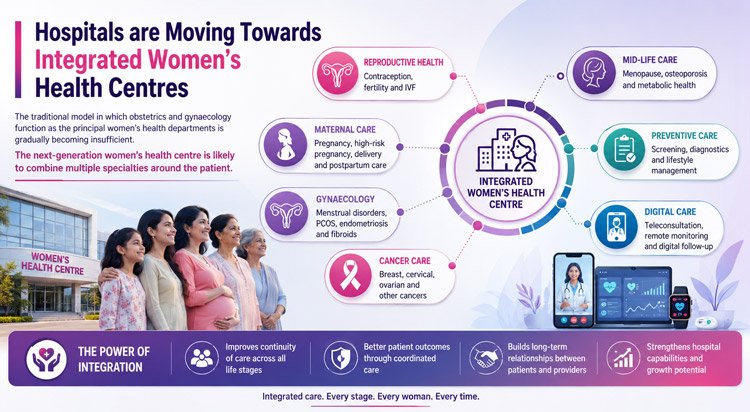
Hospitals are Moving Towards Integrated Women’s Health Centres
Government Healthcare Programmes will Remain Important
India’s public-health system will continue to shape the women’s health market, particularly outside major metropolitan areas.
Ayushman Bharat, Health and Wellness Centres/Ayushman Arogya Mandirs, eSanjeevani and national programmes covering reproductive health, maternal health, nutrition and cancer screening are creating a broader platform for access.
NFHS-6 also shows that India has made measurable progress in maternal and reproductive healthcare.
The next policy challenge is to ensure that women’s health financing moves beyond pregnancy and hospital episodes towards continuous, preventive and life-course care.
ORF similarly recommends strengthening primary care, expanding financing for women’s health services and improving gender-sensitive health indicators.
Medical Tourism Could Become an Additional Opportunity
India’s growing women’s health ecosystem also has implications for medical tourism.
The country already attracts international patients for fertility treatment, IVF, oncology, complex surgery and other specialised procedures because of its combination of clinical expertise, infrastructure and comparatively competitive treatment costs.
As Indian providers develop more comprehensive women’s health centres, the opportunity could expand from individual procedures to integrated women’s healthcare journeys.
Potential international patient segments include fertility and assisted reproduction, oncology, advanced gynaecological surgery, breast reconstruction, minimally invasive procedures and selected preventive or wellness programmes.
For medical tourism providers, however, international women’s healthcare requires more than clinical capability. International accreditation, multilingual patient support, transparent pricing, coordinated travel services and continuity of care after patients return home will increasingly influence destination choice.
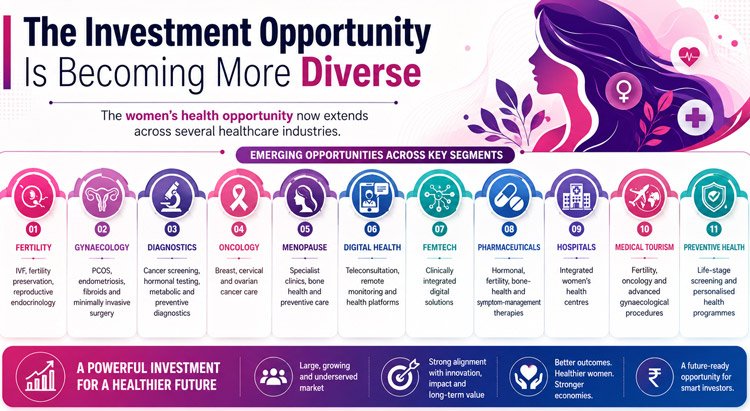
The Investment Opportunity is Becoming More Diverse
The Challenges Cannot be Ignored
The market’s growth potential is substantial, but several structural barriers remain.
Affordability is a major concern, particularly for fertility treatment, cancer care and long-term chronic disease management.
Geographical inequality continues to affect access to specialists and advanced diagnostics.
Awareness gaps mean that many women still delay treatment for menstrual disorders, reproductive problems, cancer symptoms and menopause-related conditions.
Digital inequality can prevent technology from reaching the women who may benefit most from it.
Data privacy is also becoming increasingly important as health platforms collect highly sensitive reproductive and personal health information.
Finally, the sector needs to avoid reducing women’s health to a consumer wellness category. Sustainable growth will depend on clinical evidence, medical oversight, patient safety and measurable outcomes.
What the Next Decade Could Look Like
India’s women’s health market is likely to become increasingly preventive, personalised, technology-enabled and life-course oriented.
The most important change may not be the growth of any single segment. Instead, it will be the integration of previously fragmented services.
A woman seeking help for PCOS may need nutrition, endocrinology and fertility care. A woman entering menopause may require gynaecology, bone-health, cardiovascular and metabolic assessment. A breast-cancer patient may require screening, surgery, oncology, reconstruction and survivorship services.
Healthcare providers that can connect these services around the patient’s journey will be better positioned for the next phase of market growth.
India’s women’s healthcare sector is moving into a new phase.
The country has made significant progress in maternal and reproductive healthcare, with NFHS-6 showing improvements in institutional deliveries, antenatal care and contraception. At the same time, the survey points to a changing disease burden, including rising overweight and obesity and increasing blood-sugar abnormalities among women.
Cancer, PCOS, infertility, menopause, metabolic disorders, anaemia and preventive healthcare are creating new areas of demand. Digital health and femtech are adding another layer of opportunity, while expanding hospital and diagnostic networks are taking specialised services beyond major cities.
The central shift is clear: India’s women’s health market is no longer only about reproduction. It is evolving into a lifelong healthcare ecosystem.
For hospitals, pharmaceutical companies, diagnostics providers, health-tech companies, investors and medical tourism stakeholders, this transformation presents a substantial opportunity—but also a responsibility to build healthcare models that are clinically credible, affordable, accessible and designed around women at every stage of life.
Sources & Data Notes:
Key data and insights are based on NFHS-6, Ministry of Health & Family Welfare, Government of India; Observer Research Foundation (ORF), 2026; IARC/GLOBOCAN 2022; and Tracxn industry data.
Note: Market-size figures are third-party estimates and may vary by methodology and market definition; they should not be interpreted as official Government of India valuations.