By Dr Mansimrat P. Singh, Consultant – General & Minimal Access Surgery, CK BIRLA HOSPITALS Jaipur
Surgical technology has evolved considerably, reshaping the performance of many procedures. Robotic-assisted surgery allows complex operations to be conducted with specialized instruments and a high-definition, magnified view of the surgical field. While this technology may improve precision and control, successful outcomes remain contingent on factors beyond the equipment itself, including surgeon expertise and clinical judgment.
Potential of Robotic-Assisted Surgery to Enhance Surgical Precision
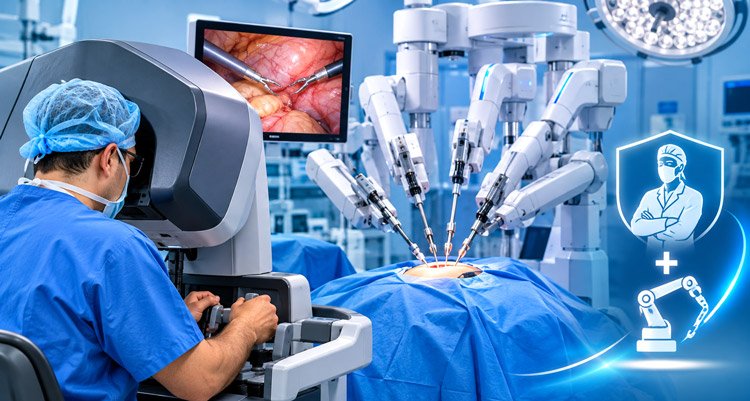
In robotic-assisted surgery, the surgeon operates from a dedicated console, manipulating controls that direct patient-side robotic arms and specialized instruments. The system translates the surgeon’s hand, wrist, and finger movements into scaled, precise instrument motions, while many platforms provide a magnified, high-definition three-dimensional view of the operative field. Robotic instruments may also afford greater degrees of freedom than conventional rigid laparoscopic instruments, potentially facilitating dissection and suturing in confined anatomical spaces or in proximity to delicate structures.
It is equally important to recognise that robotic-assisted surgery is not a fully autonomous intervention. The surgeon retains direct and continuous control throughout the procedure, guiding instrument movement and making intraoperative decisions based on the patient’s anatomy, operative findings, and physiological response. Current robotic platforms function as surgeon-controlled tools rather than independent decision-making systems.
In appropriately selected patients, robotic-assisted surgery may be associated with smaller incisions, reduced intraoperative blood loss, less postoperative pain, and a potentially faster recovery. However, the magnitude of these benefits varies according to the specific procedure, patient-related factors, and the surgeon’s experience with the platform. Robotic assistance may be of particular value in selected general surgical procedures, including certain hernia repairs and colorectal resections.
The technology can enhance visualisation and instrument control, but it cannot independently determine the safest surgical approach or manage every unexpected situation. These responsibilities remain with the operating surgeon.
The Continuing Importance of Surgical Expertise and Clinical Judgment
Each patient presents a distinct clinical context. Age, comorbidities, prior surgical history, disease complexity, and overall physiological reserve may all influence the selection of the most appropriate treatment strategy. Consequently, an intervention that is suitable for one patient may not represent the optimal choice for another.
This is where clinical judgement becomes essential. Before recommending robotic-assisted surgery, the surgeon must evaluate whether it offers meaningful advantages over conventional laparoscopic or open surgery. In some cases, a traditional approach may be equally effective or more appropriate.
Experience is particularly important when unexpected findings are encountered intraoperatively. The capacity to recognise complications, reassess the operative strategy, and make timely, appropriate decisions derives from clinical training, accumulated operative experience, and sound judgment rather than from access to advanced technology alone
Training, Competency, and Safe Adoption of Robotic Surgery
Robotic-assisted surgery requires specific training, platform familiarity, and operative experience. When evaluating surgical care, patients should consider the surgeon’s understanding of the procedure, proficiency with the robotic system, and ability to recognise and manage complications.
Ultimately, technology should support clinical decision-making rather than serve as the sole indication for a particular operation. Patients should be encouraged to discuss the available options, anticipated benefits, potential risks, and expected recovery with their surgeon. Robotic-assisted surgery is an important advance in contemporary surgical practice. However, its use should not be universal; rather, the appropriate approach should be matched to the individual patient. Optimal surgical care integrates suitable technology with clinical judgment, technical expertise, and a sustained focus on patient safety.

About Dr. Mansimrat P Singh
Dr. Mansimrat P Singh is a skilled surgeon specializing in General and Minimal Invasive Surgery with over 11 years of experience. He has expertise in advanced laparoscopic procedures that support faster recovery and improved patient outcomes. He is experienced in managing conditions such as hernia (inguinal, ventral, incisional, and hiatus), varicose veins, and anorectal disorders including piles, fissure, fistula, and pilonidal sinus, with advanced techniques like laser proctology, as well as bariatric (weight loss) surgery. Dr. Singh holds MBBS, MS, FNB (Minimal Access Surgery), MRCS (Edinburgh) and has completed a Fellowship in Minimal Invasive Surgery from Singapore. He also has experience in robotic-assisted surgery at leading centres in New Delhi and Singapore. He has contributed to academic research, including a chapter on Reduced Port Laparoscopic Surgery in the 4th edition of Comprehensive Laparoscopic Surgery (IAGES).He is committed to delivering safe, advanced, and patient-centric surgical care using modern minimally invasive techniques.