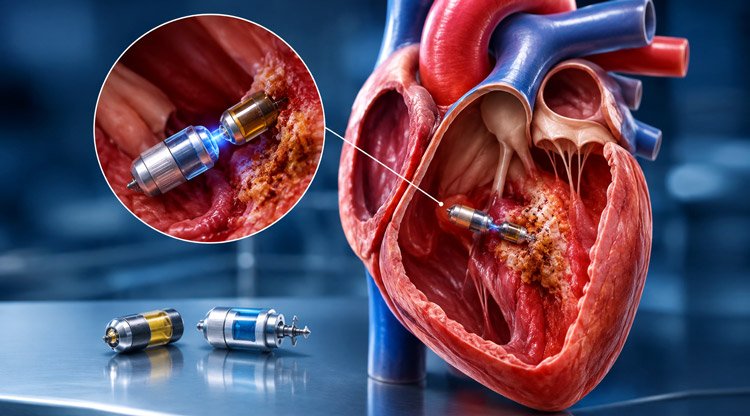
A new robotic approach could one day allow doctors to deliver medication directly to infected areas of the heart using miniature devices controlled from outside the body.
Researchers at Johns Hopkins University have developed two tiny robots designed to work as a team. One robot attaches itself to heart tissue and acts as a docking point, while the second carries medication to the site, connects to the first robot and releases its drug cargo. After delivery, the drug-carrying robot can detach and be replaced if another dose is required.
Each robot is approximately the width of a pencil tip and about the length of a grain of rice. In laboratory testing, the researchers guided the devices through an artificial heart and also tested their ability to attach to pig heart tissue.
“With just a little pinprick, you insert a micro robot and do a procedure without infection or blood loss. And you don’t need to have a surgeon operating it to get the drugs robustly, safely, and efficiently to the right place,” said senior author Axel Krieger, a medical roboticist known for developing autonomous surgical robots.
Targeting Heart Infections
The technology is being explored as a potential treatment for infective endocarditis, a serious infection of the heart’s inner lining that commonly affects the valves.
The infection can develop when bacteria enter the bloodstream and attach to heart tissue, where they may form infected masses that are difficult to eliminate. Severe cases can damage heart valves, lead to heart failure or allow infected material to travel through the bloodstream and cause complications such as stroke.
Treatment generally involves intravenous antibiotics for several weeks. While medication is sufficient for many patients, surgery may become necessary when the infection does not clear or causes major valve damage.
One major challenge is delivering an effective concentration of medicine to the infected site without unnecessarily exposing the rest of the body to the drug.
The Johns Hopkins team designed the two-robot system to address this problem.
The first device, known as the needle module, has a small barbed tip that allows it to grip heart tissue. Once in position, it serves as a fixed docking point.
The second device, called the drug module, transports the medication. It is guided toward the anchored robot, attaches magnetically and then releases the drug gradually.
Controlled Without Batteries or Motors
The miniature robots do not carry batteries or onboard motors. Instead, electromagnetic coils positioned outside the body create magnetic fields that guide the devices.
“Magnetic guidance is exciting because you don’t have to power the robot itself. It doesn’t carry batteries and motors,” Axel Krieger added in a university news release.
The concept uses externally generated magnetic fields in a way that is broadly comparable to the technology used in MRI systems. Here, however, the magnetic fields are used to control robotic movement rather than produce medical images.
Computer vision and automated navigation further help track the devices and direct them toward their target.
During experiments, the robots were able to move through the model heart, including against simulated blood flow. Tests using pig heart tissue also showed that the needle module could penetrate and anchor in tissue, while the drug module could successfully detach.
The reported results included a 100% success rate for magnetic docking and a 93% success rate for undocking. The drug module was also able to release 22 microliters of liquid over three hours.
However, the findings represent an early engineering demonstration rather than proof that the system can treat or cure heart infections. The technology has not yet advanced to human trials.
Potential to Shorten Treatment
Researchers believe the approach could eventually reduce the duration of treatment if further testing confirms its safety and effectiveness.
If the technology performs successfully in increasingly realistic models and later proves safe in clinical studies, miniature magnetic robots could offer a new way to deliver drugs precisely where they are needed. Such targeted treatment could potentially reduce systemic drug exposure while opening new possibilities for treating difficult-to-reach infections inside the heart.
(The above image is generated using AI for illustrative purposes only)