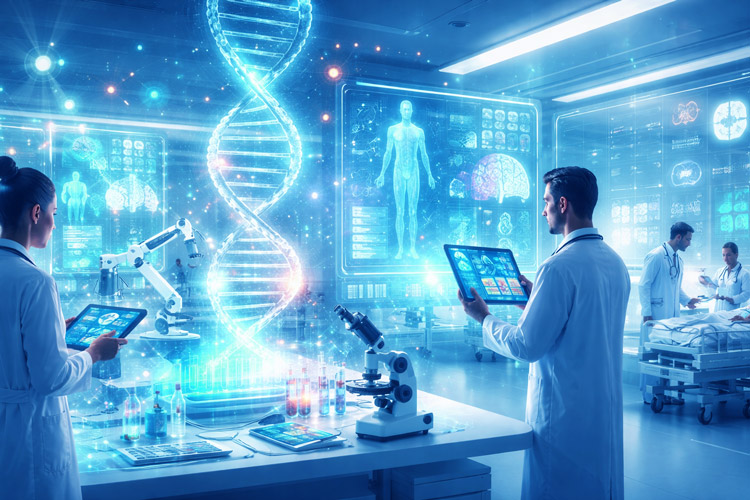
Healthcare is entering a new technological era. With artificial intelligence, genomics, and digital health tools advancing rapidly, medicine is shifting from reactive treatment to predictive and personalized care. This transformation is redefining how diseases are diagnosed, treated, and prevented in modern healthcare.
By MTT Research Desk
Healthcare is entering one of the most transformative phases in its history. For decades, medical progress moved steadily — new drugs, better imaging, improved surgical techniques. But today, the pace has accelerated dramatically. The newest and most important subject dominating global healthcare in 2025–2026 is AI-powered precision medicine — a convergence of artificial intelligence, genomics, advanced diagnostics, and digital healthcare systems. Together, these technologies are fundamentally changing how diseases are detected, treated, and even prevented.
From Reactive Care to Predictive Care
Traditionally, healthcare has been reactive. Patients develop symptoms, visit a doctor, receive tests, and then treatment begins. The emerging model is very different: predictive healthcare.
Artificial intelligence systems can now analyze enormous datasets — medical images, electronic health records, genetic profiles, and wearable device data — to identify disease risks long before symptoms appear. These tools are already assisting in detecting strokes, heart disease, and cancers at earlier stages, enabling treatment when it is easier and more effective.
AI-based risk prediction platforms can also forecast which patients are more likely to develop complications or require hospitalization, allowing doctors to intervene early and reduce healthcare costs and mortality.
AI Is Transforming Drug Discovery
One of the most significant breakthroughs is occurring not in hospitals, but in pharmaceutical research. Drug development traditionally takes 10–15 years. Today, AI is rapidly compressing that timeline.
Pharmaceutical companies are using AI to model proteins, simulate how drugs interact with the human body, and design new molecules digitally before entering laboratory testing.
Industry reports show AI-supported development is already cutting research timelines by several years and reducing development costs.
AI tools are also streamlining clinical trials — identifying eligible patients, managing data, and preparing regulatory documentation — significantly improving efficiency in bringing medicines to market.
The Rise of Personalized Medicine
Perhaps the most revolutionary change is the shift from “one-size-fits-all” treatment to personalized medicine.
Advances in genomics allow physicians to tailor therapies based on a patient’s genetic makeup. Machine-learning algorithms analyze genomic and protein data to determine which drug will work best — and which might cause side effects.
For example:
- Blood-based “liquid biopsies” can detect cancer mutations early.
- Pharmacogenomics can predict adverse drug reactions.
- Targeted therapies can be customized for specific genetic mutations rather than disease categories.
This marks the beginning of precision healthcare, where treatment is individualized rather than standardized.
Gene Editing and RNA Medicine
Another major frontier is gene-level therapy. Technologies like CRISPR and RNA editing allow scientists to correct disease-causing mutations rather than merely treating symptoms.
New RNA editing methods can modify genetic instructions without permanently altering DNA, offering safer therapeutic options.
Researchers are also using AI to design more precise gene editors with reduced side effects.
These approaches may soon provide cures — not just treatments — for inherited conditions such as sickle-cell disease, thalassemia, and certain cancers.
Digital Health and Virtual Hospitals
Healthcare delivery itself is evolving. Telemedicine has expanded into virtual hospitals, where patients can receive consultations, monitoring, and follow-up care from home.
Remote monitoring devices and predictive analytics now allow doctors to track chronic illnesses continuously. AI-enabled telehealth platforms improve patient engagement and can reduce hospital admissions by identifying problems early.
For countries with limited specialist access — including many parts of Asia and Africa — this shift may be as important as any new drug.
Smart Diagnostics: Doctors + Machines
Rather than replacing physicians, AI is becoming a clinical partner.
Modern AI diagnostic systems can:
- interpret medical scans,
- analyze skin lesions,
- evaluate heart conditions,
- and assist in treatment planning.
These systems provide decision-support to doctors, allowing them to spend more time with patients and less time reviewing data.
What This Means for Patients
The implications for patients are profound:
Earlier diagnosis — diseases detected before symptoms
More accurate treatment — therapy tailored to the individual
Faster drug availability — accelerated research and approval
Greater access — remote healthcare services from anywhere
In simple terms, healthcare is shifting from hospital-centered care to data-centered care.
Conclusion
The most important healthcare development today is not a single drug or device — it is a new medical paradigm. Artificial intelligence, genomics, and digital health technologies are merging to create predictive, personalized, and preventive medicine.
Medicine is moving away from treating illness toward managing health. Over the next decade, patients may visit doctors less often because diseases will be identified before they fully develop — and, in some cases, prevented altogether.
The future of healthcare is no longer just about curing disease.
It is about anticipating it, personalizing care, and preserving wellness.
(The above image is AI-generated and is for illustrative purposes only)