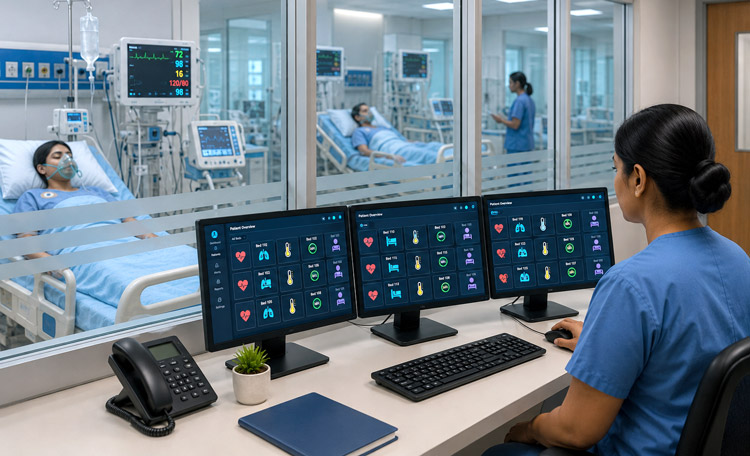
Apollo Hospitals in Madurai has rolled out a hospital-wide Artificial Intelligence (AI)-enabled patient monitoring system, marking a significant advancement in digital healthcare. The new platform continuously tracks patients’ health and helps clinicians identify signs of deterioration much earlier, improving patient safety and treatment outcomes.
The AI-powered solution now monitors nearly 150 inpatient beds, making Apollo Madurai the first hospital in Tamil Nadu to implement a centralized monitoring system across all admitted patients. The network also extends to Apollo Karaikudi, where patient monitoring is managed remotely from the central command centre in Madurai.
According to Nikhil Tiwari, Chief Operating Officer – ROTN, Apollo Hospitals, the platform continuously records key health parameters such as ECG, heart rate, respiratory rate, oxygen saturation (SpO2), temperature, blood pressure and patient posture. The predictive AI engine can detect clinical deterioration up to six hours before it becomes critical while automatically generating the National Early Warning Score (NEWS2) for every patient.
Highlighting the clinical impact, Dr. V. Jude Vinoth, Senior Consultant and Incharge, Department of Emergency Medicine, said the technology has contributed to reducing mortality by more than 80%.
“Every patient in the in-patient ward is categorised into one of four zones: stabilization (green), enhanced care (orange), critical stabilization (red), or resuscitation (blue),” Dr. Vinoth explained.
“The moment a patient’s condition worsens and triggers an orange code, the monitoring team instantly alerts the duty nurse and doctor.”
He noted that this proactive alert mechanism enables doctors and nurses to intervene well before a patient’s condition becomes critical, reducing dependence on manual observation where subtle warning signs may be overlooked.
The monitoring device is lightweight and designed for patient comfort. It is attached to the chest like a small button and remains in place throughout the hospital stay, replacing the need for bulky equipment and multiple wires.
“This eliminates the physical burden on patients, who are traditionally weighed down by heavy instruments and tangled wires,” he added.
Dr. Tiwari also revealed that the AI platform, developed by Lifesigns, is expected to be extended for post-discharge care, allowing patients to be monitored remotely from their homes. He added that doctors can access patients’ vital signs through a dedicated mobile application, enabling continuous monitoring from virtually any location.
The remote monitoring service is expected to be affordable as well, with costs estimated at around ₹400 per day, making it accessible for patients requiring continued observation after leaving the hospital.
Speaking on the broader impact of the innovation, Dr. Tiwari said integrating AI with life sciences represents a major step forward in continuous patient monitoring, helping healthcare professionals deliver timely and more efficient care.
The adoption of AI-powered monitoring reflects Apollo Hospitals’ growing focus on technology-driven healthcare. With continuous surveillance, predictive alerts and plans for home-based monitoring, the initiative aims to improve patient outcomes while making advanced healthcare more efficient and accessible.
(The above image is AI-generated and is for illustrative purposes only)