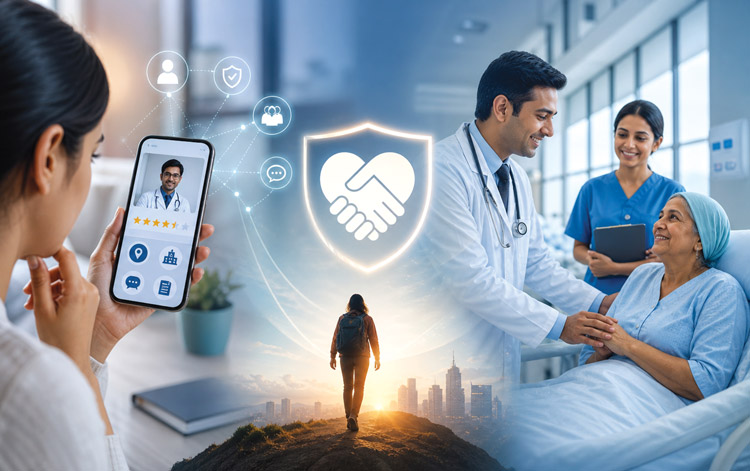
In today’s rapidly evolving healthcare landscape, patient decision-making is no longer driven solely by proximity to a hospital or clinic. The rise of digital platforms has introduced a new layer of influence—trust built online. As patients increasingly rely on digital ecosystems to guide critical healthcare choices, the balance between physical distance and digital trust is being fundamentally redefined.
By Sonam Garg Sharma
Healthcare today is no longer defined only by geography or the physical proximity of a hospital. Digital trust, a less visible but highly influential factor, is gradually reshaping the way patients access care. Before seeing a doctor or entering a hospital, patients begin their medical journey online—searching for information, comparing specialists, and evaluating multiple options.
In fact, before booking an appointment at a medical facility, 77% of patients use search engines, and nearly one in three consults multiple sources to decide which specialist to see. During this process, patients seek clarity, reassurance, and a sense of direction that goes beyond clinical expertise.
At the same time, physical distance still plays a role in healthcare, as treatment ultimately takes place in real-world settings with real doctors. However, the importance of distance has diminished. It is no longer the primary barrier. The real challenge today lies in confusion caused by excessive and fragmented information, along with the emotional stress of making critical decisions without adequate support.
Patients are no longer asking, “Where is the best hospital?” as much as they are asking, “Can I trust the path I am being guided toward?” Nearly 60% of patients delay or postpone treatment decisions when they feel uncertain or lack trusted guidance, even when quality care is available nearby.
This shift has quietly transformed how healthcare access functions, particularly for patients seeking specialized care beyond their immediate location. Medical journeys can be complex and challenging, especially when they involve traveling to another city or even another country for treatment.
India has become a major destination for advanced and affordable healthcare and is emerging as one of the fastest-growing hubs for Medical Value Travel (MVT). The sector, valued at USD 2.89 billion in 2020, is projected to reach USD 13.42 billion by 2026, driven by world-class infrastructure, skilled professionals, and growing global trust in its healthcare ecosystem.
However, even when high-quality care is accessible, patients and their families often hesitate if they lack clarity about where to go, whom to consult, and how the process will unfold. In such situations, trust becomes more important than distance itself.

This is where healthcare platforms play a crucial role. Behind many successful patient journeys are facilitation ecosystems that bridge the gap between uncertainty and access. Rather than leaving patients to navigate complex systems alone, these platforms help them find the right doctors, understand treatment options, and identify hospitals where they can receive appropriate care.
It is not simply about offering choices, but about ensuring that those choices are relevant, reliable, and aligned with patient needs. The focus remains on reducing stress for families during some of their most vulnerable moments.
Digital trust is particularly important because it does not replace physical care but enables patients to feel confident enough to access it. Online recommendations alone are no longer sufficient; patients expect consistency, validation, and credibility before making decisions about their healthcare.
Today, many patients base their choice of doctors and hospitals on online reviews, feedback, and digital interactions. As a result, healthcare has evolved into a hybrid experience—where emotional assurance begins in the digital world and culminates in physical care delivery.
Yet, the human side of healthcare often goes unnoticed. Every case carries emotional weight—fear, urgency, confusion, and hope. Families deal not only with illness but also with navigating complex healthcare systems under pressure. In such moments, timely guidance becomes essential in providing clarity and easing emotional strain.
Over time, this has led to the emergence of more empathetic facilitators who recognize that trust is built not through claims, but through consistent outcomes and patient-centric care.
The balance between digital trust and physical distance does not have a simple answer. While physical care will always remain essential, access to it increasingly depends on how confidently patients can navigate their healthcare journey.
In many ways, trust has become the true currency of modern healthcare—shaping decisions more than geography, infrastructure, or cost.
As the healthcare ecosystem continues to evolve, the future will belong to systems that seamlessly integrate both digital and physical experiences. They will be those that reduce confusion, build confidence, and ensure that no patient feels alone in their search for the right care.
In the years ahead, distance will matter less—but trust will matter most.

Sonam Garg Sharma is the Founder & CEO of Medical Linkers, and a seasoned healthcare consultant and medical tourism expert. With over 15 years of experience across telecom, media, and healthcare, she established her healthcare venture nearly a decade ago to promote healthcare expertise globally. A pioneer in medical tourism, she has helped hospitals expand internationally and build cross-border networks. Passionate about patient access and innovation, she continues to position India as a leading destination for medical and wellness tourism.